The Cisco Kid
The Colossus of the Drylands writer had a hit with Pistolheart. Now he’s back with a bullet.
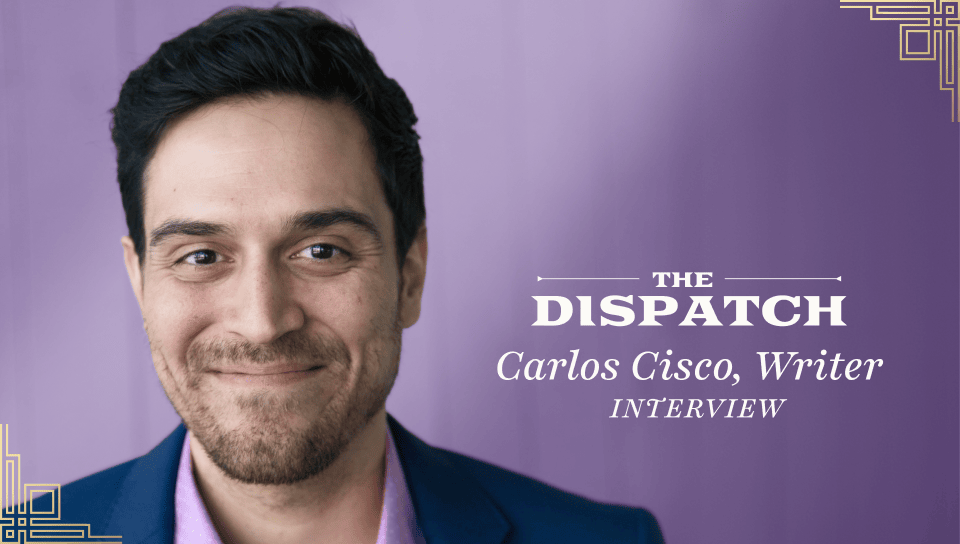
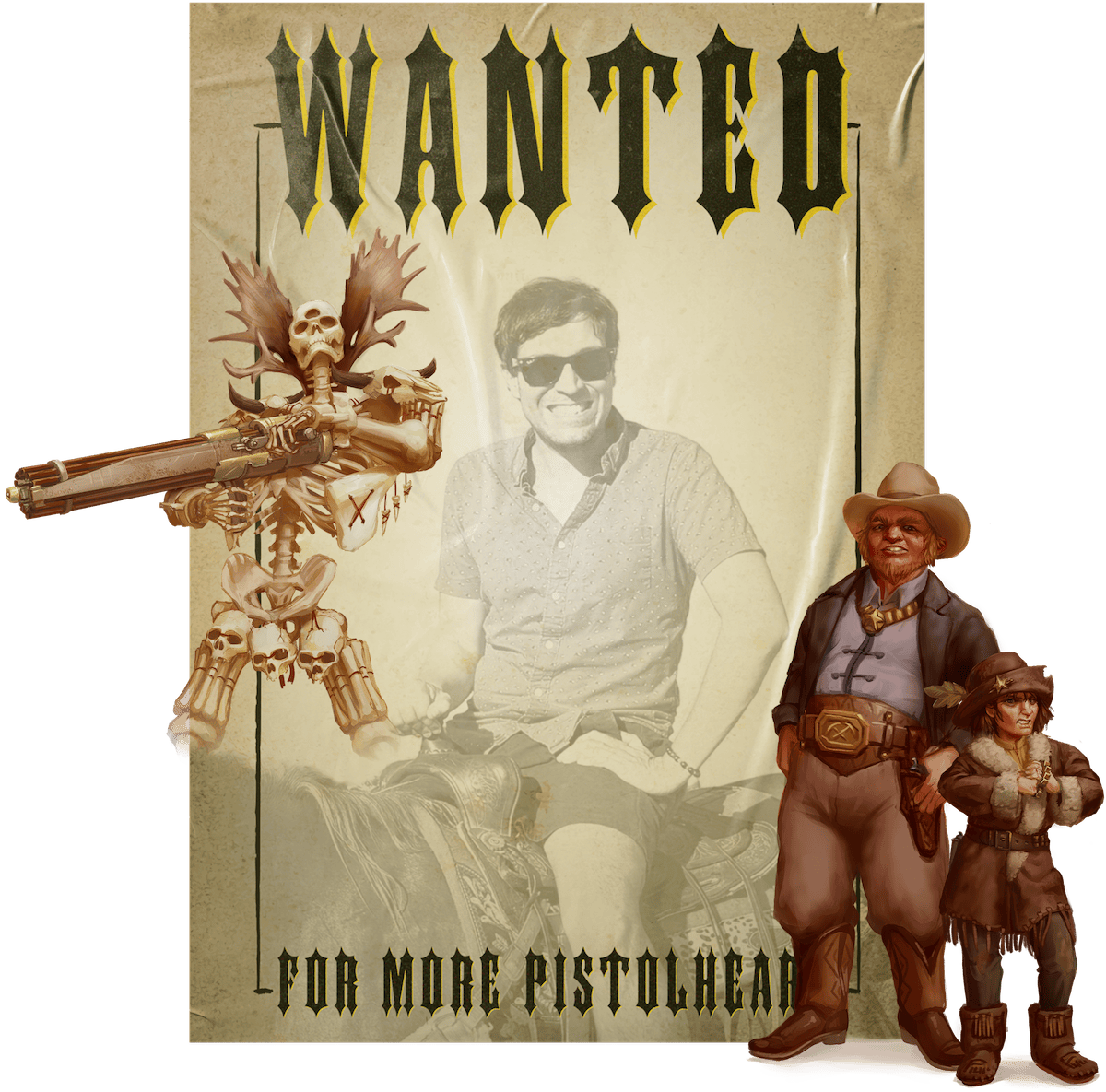
Carlos Cisco works in two fields that are notoriously bad at predicting their own future. In Hollywood and tabletop alike, you usually only know what mattered after the fact.
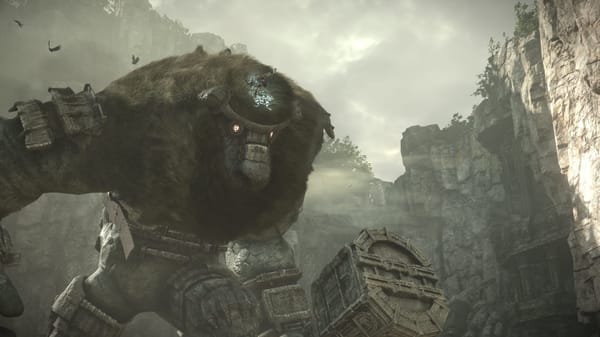
But Pistolheart, Cisco’s western supplement published last November, had the unmistakable feel of a hit: not just because it arrived at the right time, after Cisco helped write The Colossus of the Drylands for the core rulebook, but because it was so crisply, confidently made. It expanded the Drylands without feeling derivative, and showed how much room there is inside Daggerheart’s young ecosystem for a creator with a strong voice and quick draw.
With Volume 2 now on the way, I wanted to talk to Cisco about Westerns, screenwriting, game design, and what happens when a side road opens into a frontier.
Carlos spoke to me from his home in Los Angeles. This interview has been edited for length and clarity.
My first western was High Plains Drifter. You?
Tombstone. I was 12 at a summer camp where we were going to the OK Corral as part of it. When we stayed in the motel overnight the camp counsellors showed us the movie.
“I’m your huckleberry”
I still love it. I still quote Curly all the time. "Well... Bye."
I’m a Tomorrow and Tomorrow and Tomorrow fan…
Oregon Trail. I loved that game.
Right?
I can't say for certain when exactly I first played it but it was all through elementary school.
Generation-defining.
If I really think about it, it's the first game I played with emergent storytelling. You'd name your family after all your friends and laugh with them when they died of dysentery or a stubbed toe. While the adventure wasn't randomized, your outcomes were. Probably what kept me coming back to it.
These aside, were you into Westerns as a genre?
I never really thought about them much growing up. But I did grow up in both Hawaii and New Mexico, both of which have a deeply rooted cowboy culture ingrained in their history. I grew up going to rodeos and living near ranches and cattle farms. I think a lot of my appreciation for the genre came later, especially realizing how much I took in by osmosis.
How does cowboy culture differ between those two states?
Hawaii had Paniolos. Arguably before the archetypical cowboy was even born. Paniolos came about in the 1700's when King Kamehameha brought Mexican vaqueros over to teach Hawaiians their cattle herding techniques. New Mexico is pretty similar to Texas in its embrace of the western aesthetic and culture, but we have less of that lone star attitude.
I’m curious what you think the genre offers us? If we use stories to explain our lives, what do we use the Western for?
It’s a complicated genre. Most Western media are piss poor representations of what and who were galloping around there.
Tell me about that.
Our film canon almost completely ignores the black cowboy. Which in and of itself was born as a derogatory way of referring to black cowhands, who were really the ones doing the lions share of the work.
To a lesser extent in terms of representation, latino people are often relegated to villain or minor supporting roles. And don't even get me started on how the genre has treated indigenous people.
Approaching it from a modern lens requires you to keep all that in mind, even if you're in a fantasy world with robot people and walking mushrooms.
And yet.
And yet. I do think there will always be an allure to the aesthetics of the genre. The hats, the revolver, the sparse but beautiful landscapes, horses, the idea of the undiscovered frontier, that buttery Texas drawl...
But it was a time drenched in darkness, blood, exploitation, and those that chose to make their way there were a different sort. I think it's a good genre for stories about desperate bids for survival, about fighting larger than life odds, and exploring (what will likely turn out not to be) undiscovered country.
In some ways it’s America’s answer to Europe’s medieval mythology: saloons, cowboys, and train robberies filling in for taverns, knights, and dragons.
And in the Drylands you can have all six.
So what genre brought you into TTRPGs if not Westerns?
Like many folks I came in through high fantasy. AD&D 2nd Edition in middle school. But once I hit high school I branched out into a lot more horror with the White Wolf games.
What did you learn from fantasy?
It doesn't ask a lot of you. Sure, there's tons of potential lore every GM wishes their players would engage more in... but the base fantasy setting is something we have culturally ingrained in us. We all have an idea of what a wizard is or what a knight looks like, even if we don't know any world details. Don't know the answer why something is the way it is? Magic or a god 9 times out of 10. That's a bit reductive, but I do think it's what makes it the most accessible genre of TTRPGs.
Curious how you see sci-fi, given your day job.
It feels much less accessible because it asks us to be able to separate what is real science from science fiction in real time while still absorbing the narrative. Even in the most meticulously crafted settings, fantasy as a genre is, perhaps, a less concerned with the how things work and more with the why, while I think sci-fi is the other way around. The why is all vibes. The how requires player knowledge, which is always on a dial.
Let’s talk career. What’s been your journey into screenwriting and game design?
They are pretty intrinsically linked, even if I didn't know it at the time. I grew up playing games and loved creating 'cinematic' moments for my players that were narrated along to specific music. Like a video game cutscene. It often got a little railroad-y because I wanted them to get to that outcome which... well we all know how well prep stands up to first contact with players. I let that habit go.
I started in theatre, wanting to be an actor, (mercifully) having that beat out of me. Then I moved on to playwriting and screenwriting. Games were never really a focus, mostly because I had no idea how to break in.
What changed?
When I was going through a long fallow period in my career I was considering a change and applied for a job at Wizards. I interviewed, with no experience other than DMing home games and home brewing design, and it went well enough. But I got a rejection on a Monday, and that Friday Michelle Paradise (the incoming show runner of Discovery) called me to say I was hired as an assistant.
Just to stretch myself, I started working on giant DMs Guild collaborations. If I look back at the total amount of sales from all of those my royalty cut doesn't even amount to as much as I made off my last freelance contract. Obviously it wasn't about the money, but it puts things into perspective in terms of where I started and where I'm at now. Those collaborations, combined with my recent promotion to writer on Star Trek, led to some bigger jobs.
Live long and prosper.
The timing of everything has been kind of kismet. I'd be lying if I didn't leverage the cool factor of being a TV writer on Star Trek. When I reached out to Jim Johnson at Modiphius, after they got the license for Discovery, it felt like a pretty easy fit being that I was a designer with some published work and a writer on the show. That book was the first hard copy I got to hold with my name in it.
Same thing happened with James Introcaso over at MCDM. I met him on a charity stream the night I was promoted just after he started there. We kept in touch about a couple projects and when Arcadia came about I kept pestering him to pitch. Ended up writing three articles across its run. And those were the first feet I got in the door.
Who else?
I originally branched out from D&D as a way to find new IP to option that other people weren't looking at. I've adapted Roll20's Burn Bryte, Chris Bissette's The Wretched, and I'm currently shopping around an adaptation of Banana Chan's Forgery that we co-wrote together. I think that the more I play and run games, the more nimble I get with pitching anything and rolling with the punches when things change. Games I play become story seeds that may turn into something else down the line.
What’s the itch screenwriting and design scratch?
Sort of two sides of the same coin. Screenwriting really lets me explore the "Why" of a story. Why do I need to tell this story? Why are these characters acting in this way? Why is it relevant now? Game Design really lets me explore the "How." How do I make sure the players and GM have a good time? How do I get them to interact correctly with the cool thing I have in my head? How can I supply or support a specific experience a table is looking for?
What’s informing all of this? What are you watching or reading as you grow, especially Westerns?
David Milch's Deadwood is maybe one of the very best entries in the genre, period. Graham Yost's Justified, Vince Gilligan's Breaking Bad, and Ang Lee's Brokeback Mountain are all up there among modern Westerns. The Wind by Teresa Sutherland if you're into western horror. Sukiyaki Western Django is a really wild, weird west/samurai mashup by Takashi Miike. Both Vampire Hunter D movies are Western Horror stories cloaked in a sumptuous Gothic skin.
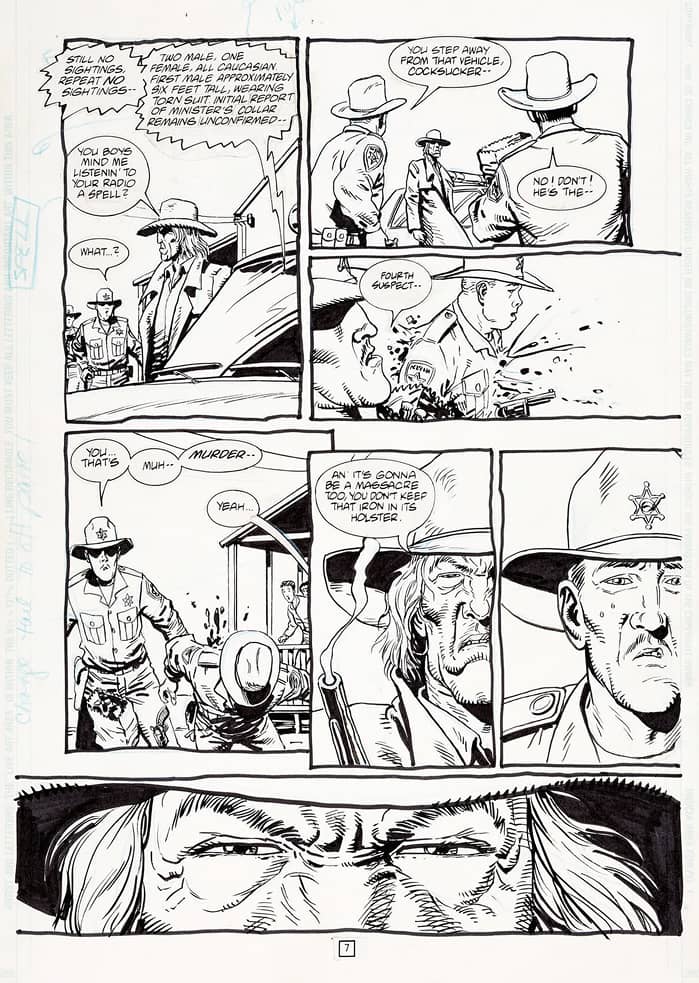
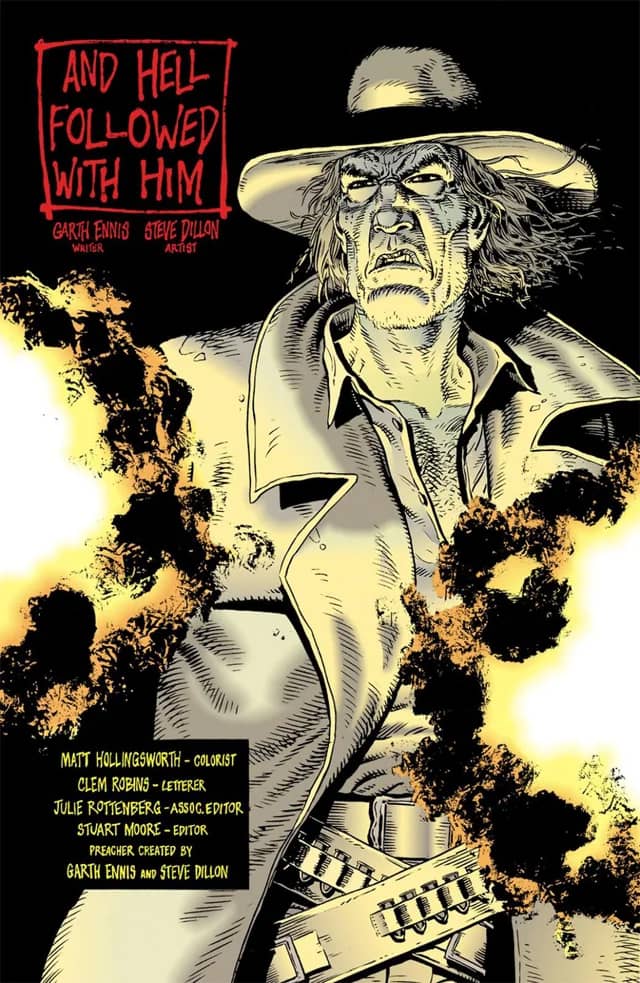
Preacher: The Saint of Killers. Story by Garth Ennis. Art by Steve Dillon.
Garth Ennis' Preacher was a pretty seminal graphic novel for me growing up. The Saint of Killers and the story of his creation is still something I think about a lot. That figure in particular impacted one of the nastier adversaries in Volume 2 [of Pistolheart].
Tell me about creating an adversary. What’s your way in?
Sometimes it's a joke come to life (looking at you, Yumgrub). A lot of the time I see or read something and think about how I can recreate that experience at the table. The Emperor of Dirt/Nothing is a prime example of that. That's just the result of me trying to figure out how to simulate [Deadwood’s] Al Swearengen and [Red Dead Redemption's] Dutch Vanderlin in Daggerheart.
It all comes down to how much I can communicate about the story/lore/biology/etc of this adversary through its mechanics, with as little narrative fluff as possible. Those are the building blocks a GM can use to tell a larger story around a creature. What do its abilities and traits tell us about the world around it and how can we use that to strengthen its narrative weight? If I can do that, I consider an adversary a success. Slap a pun in there and you're golden.
What about the colossi and Drylands? How did that all come about?
The starting point was me telling Spenser [Starke, Daggerheart's Lead Game Designer) that I wanted to work on anything with a colossus in it, but someone else had already picked it up.
So as I was working on the Witherwild, I was also planning a much needed vacation. (I think I was also on contract with MCDM for some Draw Steel stuff at the time. Needless to say I was overloaded.) Shortly before the trip, Spenser or Elise reached out about the colossus frame and I didn't even hesitate. I was told not to worry about mechanics or anything, just nail down the setting and the principles. There was very little to the prompt, just that there must be colossi. I looked at the existing frames and we had a lot of fantasy going on. So I pitched a curve ball. What if this was more of a fantasy western setting. Cowboys vs Kaiju. Spenser said to run with it and so I did.
Did it evolve from your initial pitch, or ship as planned?
Now I gotta say, if you absolutely adore Colossus in its current form, you gotta show your love to Rowan [Hall, Daggerheart Game Designer]. My initial document was much... weirder. It had a secret sentai society trying to build a colossi from dead pieces. Kudamat was not a god, but an alien being that crash landed here... kind of like Lavos in Chrono Trigger. The other colossi were originally the defenders of this place—corrupted to Kudamat's will.
It still had the gold rush aspect to it. The Drylands were wealthy because the rise of the colossi was pushing precious gems and metals to the surface. So there would be literal geysers of gold that people would prospect from. When I got back, it was much closer to what we have now, which is darker in tone with a great mixture of classic and modern western vibes and the gold rush themes shifted to essentia mining. Rowan's pass on my work made it 100x better. I really love the addition of essentia, simply because it gives a reason that magic was not a driving force of progress until this particular epoch.
Now we come to Pistolheart.
Pistolheart.
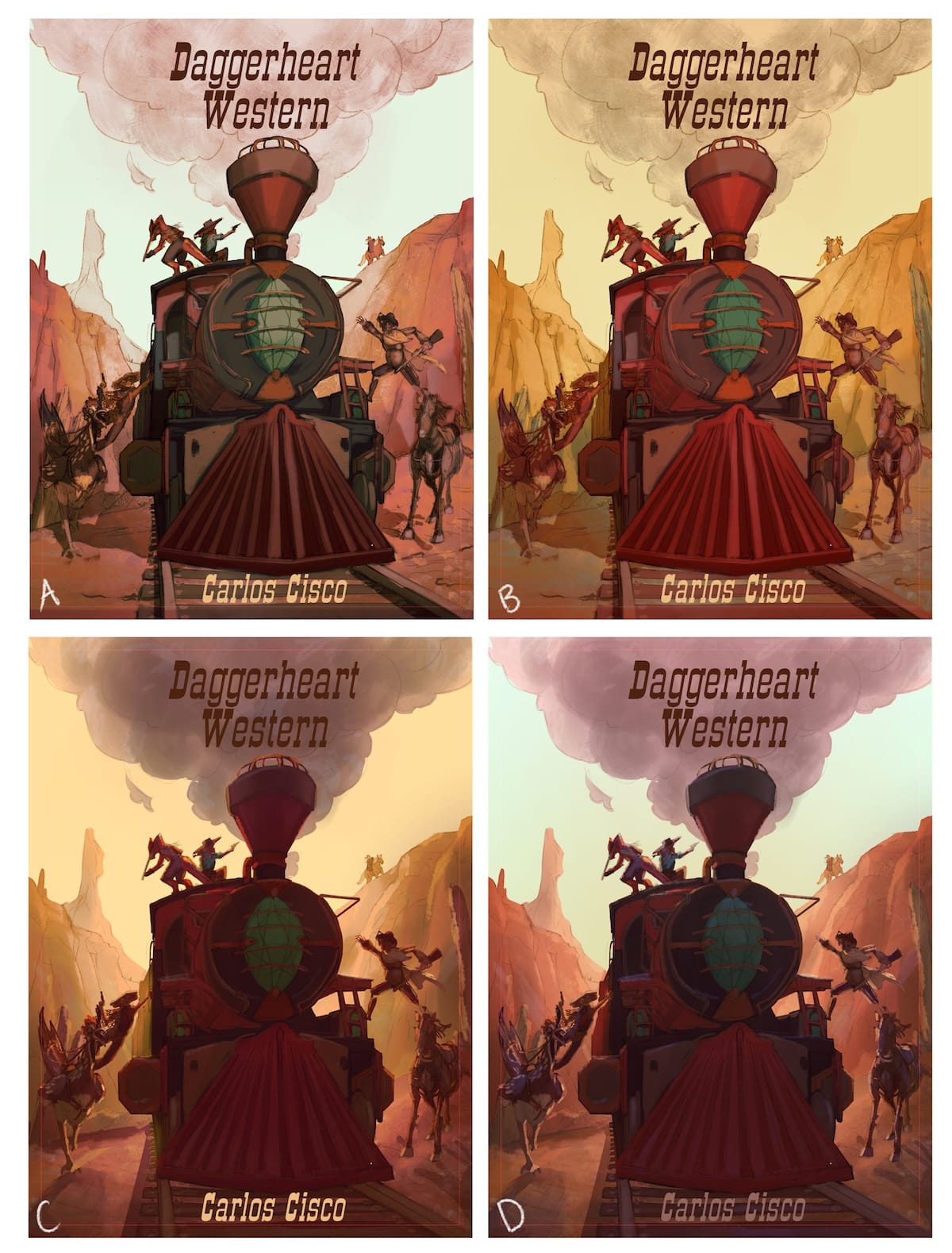
It’s your own project. You roll it out in phases to gauge demand, but it’s still a risk, financially and to your personal brand.
It was.
Is going western, rather than horror or sci-fi, just de-risking? Using the momentum of Drylands to do your first solo Daggerheart thing? Or is there a conversation with this world and these themes you wanted to continue?
To be honest, I saw a gap I could fill and I wanted to do it before anyone else did. I knew I couldn't make any, even semi-official extension to Colossus because of the CGL, but when I looked over the 3rd party stuff that was released already, it looked like an underserved market. So I pounced. I was coming off some contracts and there wasn't much else on the horizon before the end of the year. It was the conflux of timing, Colossus GMs clambering for content, and proximity to the work in core that I knew I could use as a springboard.
What did it teach you about being your own publisher?
It taught me that staying small and flexible, at least in these early projects, keeps me from burning out or spending too much money. It also taught me that I can let it breathe a bit, and take some bigger risks. I learned a lot about budgeting. I Still don't like doing it. All in all, I do enjoy the freedom of the product being mine. But I also really love not having to do all the things you do after turning in your writing assignment. It's a lot more work than I ever realized.
How about you personally? You know how to write and design games—but creating momentum, selling directly, building community… are these things already in place from making a living in Hollywood? Or are you finding yourself in foreign territory? aka: How are you feeling about the grand experiment so far?
Woof! Hate it! Hate self marketing. It's the worst part of all of this. It's 90% of the reason I didn't crowdfund. But it's hard, because you gotta make people realize you exist, but you also don't wanna be too pushy in spaces you haven't established yourself in yet.
Maybe some of it was in place. I did a lot of messaging, boosting, and social media community building during the WGA strike. I was a Lot Coordinator so a lot of people were looking at me for messaging, so that certainly helped. I also like to think that, in general, I'm not an asshole. Which really goes a long way and people clock it immediately if you are.
Hard agree.
I also learned a ton from Matt Colville's Community video (actually inspired me to take the leap into this) and MCDM's overall approach to releases. They would release stripped down chunks of playtest material on the road to releasing a full product. That allowed them to iterate, change things, make mistakes and course correct—all with a really low risk factor. My process is the even more compact version of that. Without any obligations to fulfill I can move at my own pace because this isn't the only thing I have going on.
Tell me about the practical parts of your writing/design process. When and where do you work?
I'm a morning writer, whether it's games or screenwriting. If I'm not on a Job-job (with set hours), I usually start before the sun is up and work till around 10 or 11am. Then I try to grab a nap and or lunch in no particular order. If I'm feeling nasty I work through the afternoon. But I burn out fast after 3pm. I'm lucky enough to have a home office I can work from and prefer in that very focused environment. But I can work almost anywhere.
Do you draft quickly and refine slowly or vice versa?
Ask any of my collaborators and they will tell you... I am very fast. I can churn out a first draft very quickly. That said, I tend to iterate a lot. Even before I get to any testing, I fiddle, send it out for some feedback, fiddle some more. I benefit greatly from a good editor. Sebastian Yue(Volume 1) saved my ass multiple times on just... inane little grammar misses and shortened those stat blocks immensely. Rob Hebert did developmental editing on Volume 2 and really helped me refine a lot of the language of the new mechanics. He challenged me a lot, which I appreciated, but always helped me work toward my design intent.
How do you use playtest feedback?
I'm pretty seasoned with taking notes. All of my work with MCDM went through rigorous playtesting and the folks over there always let me take a crack at revisions, which helped me think about how to and when respond to feedback.
But for Pistolheart it's been a combination of things. Some of it I just farmed out to folks who expressed an interest in something specific (like a subclass), and there's been a trickle of feedback coming in. Other times I would have really seasoned GMs run a series of encounters for their players and report back with what worked, what didn't, and what gaps they were able to fill in on their own. And then there were my own tests where I had a mixture of professional designers and folks from my home games. All of which give really insightful feedback and led to what the subclasses ultimately ended at.
Playtesting is where I heard about Rumours. Was that mechanic working backward from the genre? Or an ah-ha that emerged in playtest?
A little bit of both. I feel like a hunt/search/investigation is pretty laced into the genre. But Rumours and Investigations came because I wanted to make an adversary so well prepared and that was impossible to kill until you exposed his crimes.
But if I'm thinking about where the mechanics are rooted, it would be from my time working on, playing, and writing Candela Obscura. So much of TTRPG rules are about how to facilitate a story through mechanics. But very few can tell you how to tell a compelling story with those mechanics. I really loved the narrative potential of the quantum clue in Candela (a clue flexible enough that can be where it needs to be if the PCs go way off the rails). I also wanted to embrace the philosophy of play to find out, so that not even the GM would know the answer to what is true or false until PCs do. It's got a little Brindlewood Bay DNA in that regard.
The results of the rolls with Fear and Hope shifted around a few times until we got the feel just right. But ultimately it was a late change to create a new enemy type (the Enigma), that helped put some of these investigation based enemies under their own mechanical umbrella that allowed them to affect the scene even if they weren't present that really cinched the whole thing together. It also made the whole new mechanic justified in a different way.
Rumours feels like it should be in the core book.
The way I see Rumours is that it's a widely applicable mechanic that a lot of GMs will be doing instinctually, but I wanted to give a way to codify that for GMs that might need a tool (and a fun handout) to help track a long term search or mystery. That's all it is. A tracking mechanic, somewhere between a countdown and tokens.
I think any mechanic that a Frame introduces is going to be more successful the more narratively modular it is. Folks are gonna use the colossi mechanics in all types of campaigns. Not just the Drylands. Everyone loves a fight against a big ol' thing. That's what I'm hoping for Rumours.
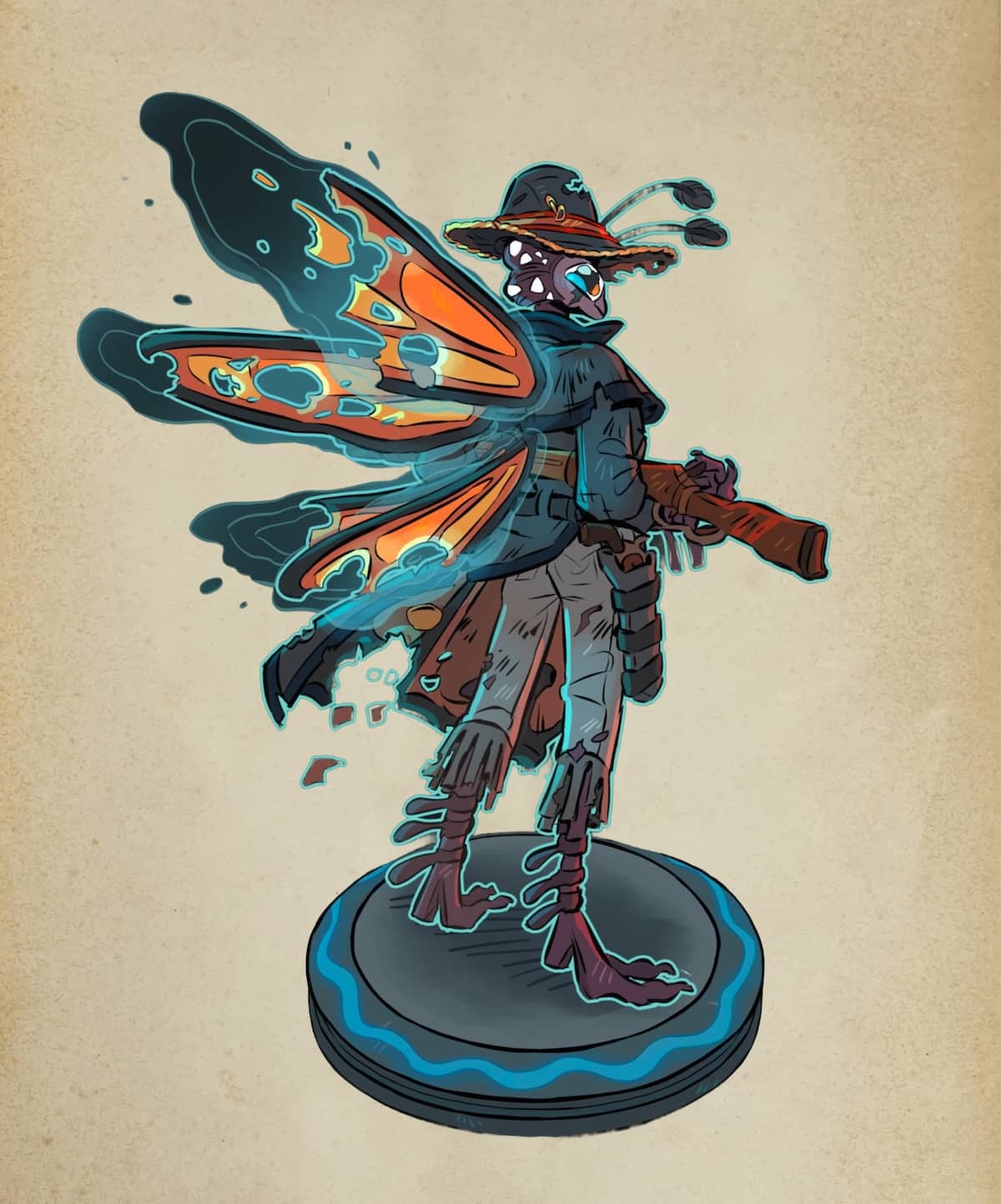
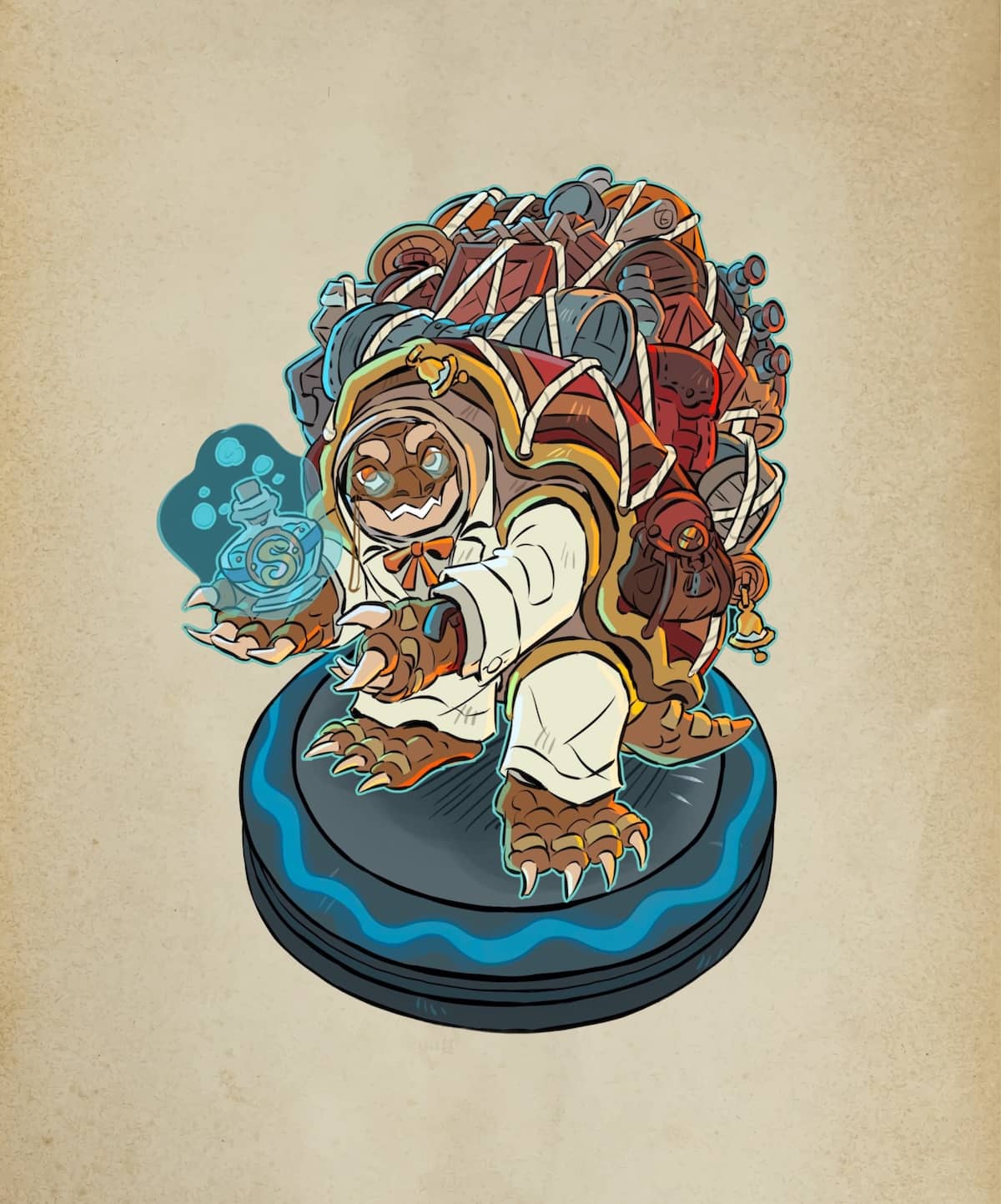
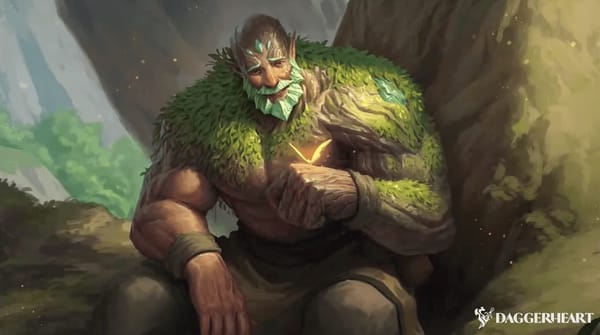
The Coffinbreaker Sorcerer and Snakeoil Bard from Pistolheart Volume 2.
Tell me about building a team and working with artists.
The team, as it were, was sort of cobbled together from what and who I had available. Ashe has played in my home games for the past 5 years and is a stellar board artist for animation. I love their style and when I pitched the project to them they jumped at the opportunity to pitch in. Clemson, similarly. He's a good friend of my dad and when I told him what the project was he was excited to see his watercolors repurposed in an entirely new way.
Michelle I'd worked with on my second adventure, where she did the cover art for it. I'd seen her work evolve over the years and I loved where she'd arrived. When I pitched the cover art to her she got excited. I didn’t hesitate when asking her to do the Adversaries for Volume 2, and if I can afford to I’ll hire her for 3 & 4 for consistency.
Carey Pietsch, who a lot of folks know from doing the Adventure Zone comics, came through another friend, and she offered me a really reasonable price. I love what she did, spinning off Ashe’s designs, but keeping it in her own style.
But if we want to give credit to the unified look and feel of the book, that credit goes to Luna (who did layout). She really turned a bunch of art assets into something visually sumptuous.
Favourite art?
Volume 1 is the cover art, easily. But I also love the marshal seraph. In Volume 2 it's either the Catacomb Kid or the Coffinbreaker Sorcerer. That fairy goes hard. Special shoutout to Per Janke, and the little ribbit cowboy he did in the Cattle Drive environment.

Lightning round.
Hit me up.
Stage coach or club car?
Stage Coach for aesthetics, club car for the ride.
The name of your ranch?
Central Dogma.
Pork and beans or potatoes and onions?
Potatoes and onions.
Colt .45 or Winchester ’73?
Winchester!
It’s high noon and you’ve got a date with destiny. Who’s the one CR cast member at your side?
I'd like to say Travis because I think his Texas drawl gives me an advantage in that situation but I do think Laura would be the quickest draw.
You’ve laid the varmint low. What’s your trademark quip?
It's past your bedtime, bub.
Die of dysentery or stubbed toe?
Stubbed toe. Dysentery is no way to go.
Thank you Carlos.
[Tips hat]