Deconstructed: Fallen Warlord
Fight a fallen god, then fight them again, but harder!

WHAT DRIVES A GOD to break the spirits of heroes? What cruel shards of divinity coalesced to create a being who inspires fear in those who do evil? Like so many of the Adversaries in Daggerheart, the Fallen Warlord is a story waiting to be told.

But does he live up to his hype? Is he something so powerful that the most powerful evils among your rogues gallery secretly whisper about this once divine being in fear?
The Realm-Breaker is pretty sturdy at a 20 Difficulty with some pretty high thresholds. It would require a decent resource spend to deal 66 damage on a hit. Add to that the 2d10 damage reduction and you’re likely to see 4-6 successful action rolls before it changes phases to the Undefeated Champion. It has a good attack modifier that should help you to hit frequently. While it starts with rather middling damage, its phase change increases both its modifier and damage, and an increase to its Relentless means that it can do so more often. Effectively, with this phase change, it trades a more solid defense for a more robust offense.
Looking at its motivations, we can see that it is a diabolical figure concerned with corruption and conquest. It is described as a Fallen God, a form of devil in the lore of Daggerheart (which you can read about on page 11) and it has broken the spirits of many a hero who would dare to cross its path. It’s almost as if the Divine Usurpation Environment was meant for this Adversary. Of note, it is motivated to BREAK THE WEAK and PUNISH THE DEFIANT. It would give no quarter and attack at every opportunity on its way to claim dominion over the Circles Above.
When evaluating an adversary as an end-game threat, you want it to be something that creates both a fun experience for the players, but also an encounter that threatens the mighty heroes. One of the biggest complaints that people coming from d20 TTRPGs to Daggerheart have is that Solos are a misnomer. They only cost 5 Battle Points and for a fresh party, they’re usually easy to stomp. But that is sometimes a design choice.
As a designer, here’s my checklist when I'm making a standalone threat for the PCs:
- It should have plenty of HP. Fourteen+Tier at least. It doesn’t have to have that many on the stat block if it has a way to heal itself, but healing should be metered.
- It should be able to keep most incoming damage below its severe threshold. Resistance and damage mitigation are good examples of this.
- It needs a way to do HP damage to multiple targets via an AoE.
- It should have access to both types of damage to prevent your guardian from tanking everything.
- It should be able to reliably make PCs mark armor/HP and at least one other resource (Stress/Hope) each GM turn.
Let's see how the Fallen Warlord stacks up to these design goals:
- ✔ It has Relentless and Momentum which should signal to the PCs that the threat is real and immediate.
- ✔ Between its first phase and second the Fallen Warlord has 19 HP.
- ✔ It has a form of damage mitigation with its armor, though it becomes less effective later.
- ✔ Both Tormenting Lash and Shattering Strike do AoE damage in a Very Close range.
- ✔ They also cause additional resource depletion.
- ✔ It also has Doombringer in both phases, which is sort of like Terrify in that it can cause PCs to lose Hope on an attack, though this one qualifies that the PC must mark HP from the attack (a trait its summoned minions share).
The Realm-Breaker has an interesting countdown in All-Consuming Rage, which starts when it takes the spotlight. It's a decreasing countdown that triggers Presence Reaction Rolls and basically guarantees that every PC marks at least 1 HP each time it pops off. Then it summons a bunch of minions. THEN it starts over, only at one lower. If it cannot start over, all the PCs make Death Moves.
All-Consuming Rage is a great feature (who doesn’t love rending flesh from bone?) but it's unlikely for the decreasing countdown to get all the way to zero given it would need a whopping 36 PC action rolls. Instead—if you want to keep this imminent threat as a ticking time bomb rather than a hit/miss outcome—it might be better as an Environment Feature that lasts the entire battle. If you were to modify this, I'd bump the countdown's starting number up to 10 and not use the Undefeated Champion's Endless Legions, which has some overlap with All-Consuming Rage.
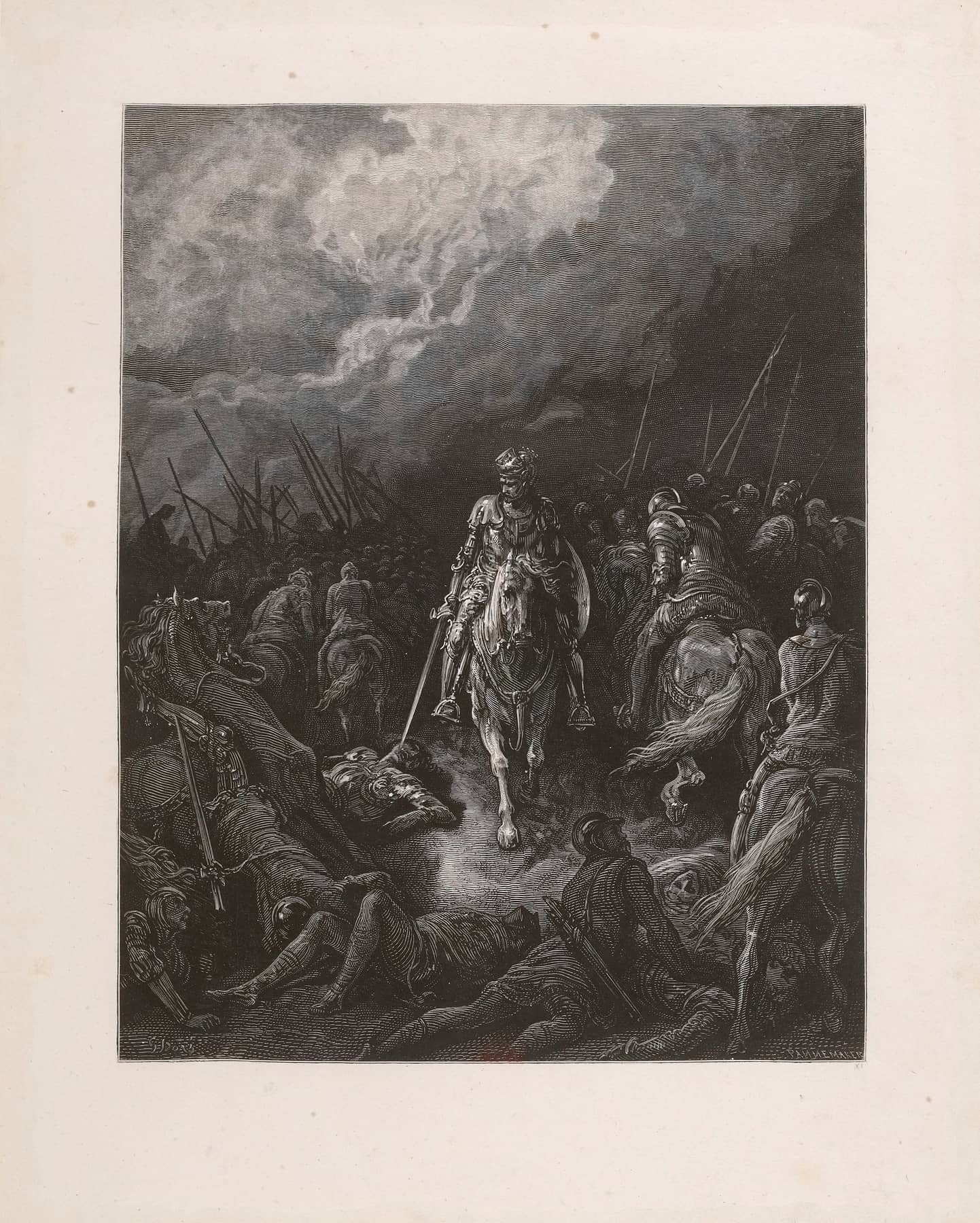
Circle of Defilement is a little early phase change bonus for the Champion. (Remember: they get the spotlight immediately upon phase change and Circle of Defilement starts when the Undefeated Champion is in the spotlight for the first time.) Assuming you roll low, the Undefeated Champion would certainly press what advantage they have by using 3 standard attacks against the most defiant (read: highest HP) PC. If it’s higher than 4, then un-evening the odds by bringing more of the Endless Legions into play and hitting the group with a Shattering Strike might be worth doing before ending with a standard attack against a PC they failed to hit with Shattering Strike.
This adversary has everything (and then some) that I look for in a challenge to the PCs. Is it a good one for your party? By this point in your game, your PCs probably are well-versed with their abilities and have plenty of goodies to help even the odds. But, you also know some of their tried and true tactics and can use that against them.
If you don't think this sort of encounter works for your players, you can always seed in a way to save this wretched soul from its eons of torment in a campaign-ender that saves the Circles Above.
Daggerheart Deconstructed is written by ENNIE Award-winning writer Chris Davidson, author of RightKnight's Guide to Making Custom Adversaries, one of the authors of Incredible Creatures, and Additional Writer for the Daggerheart Core Rule Book.