Deconstructed: Sallowlands Episode 3
Those who wish for safety may find it here, but the cost could be your undying life.
[Ed: Video starts at encounter with Petra]
THE END OF EPISODE 2 showed us everything we needed to know about the Tower of Oxudos. They demand loyalty and faith to the prophet and his edicts. But there are those whose faith in the absent gods has wavered. They no longer blindly follow the words of a prophet that may no longer live, and for their heresy, they are hunted down and executed.
The military forces of the Tower are, as Alphonse described them in episode 1, “zealous, full of fear as they are full of tradition.” With the scripts written across his gnarled and scarred face, it’s likely he knows all too well about the Templars' enforcement of traditions. When Matt gives the party control of the scene, they split off in different directions, searching for information and finding a dissenting faction within the tower named the Horizons.
Later, after escaping the Templars' search for the heretics in the garden, the party returned to their rooms believing no one knew of their involvement with the Horizons. But Laura’s Presence roll with Fear when they were trying to escape unseen prompted Matt to “Make a Move the Characters Don’t See.” Likely, the people of the tower wanted nothing to do with the troublesome PCs and turned them in to the authorities. Given the gap in play, the PCs assumed the matter was settled, and that Bowen had turned them in. By then, it was too late. No glider was going to save them from the beatdown that was waiting for them.
Enter Petra, Exemplar Archon of the Tower of Oxudos. With scripture in one hand and blade in the other, she cuts an imposing figure capable of dishing out divine punishment.
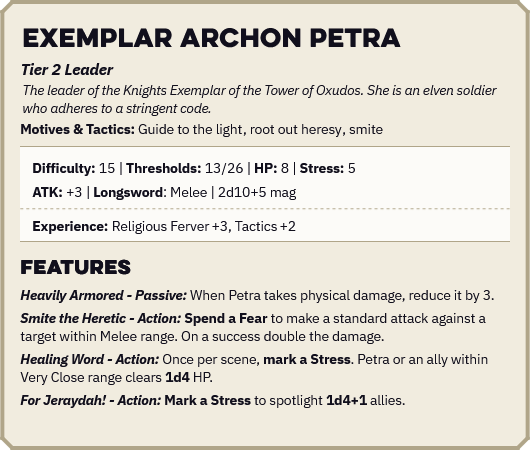
Like Endroth, Petra bears a striking similarity to another Adversary in the core rules. This time, Matt has reskinned the Tier 2 Knight of the Realm. Instead of having the Knight's mounted features (Chevalier and Calvary Charge), Petra has features that make her more like a Paladin from D&D.
Her first new feature is Smite, which costs a Fear to use, but on a success does double damage. Features that do double damage typically require an extra circumstance. Here, that circumstance is paying the cost upfront: since stat blocks read in plain language, "Spend a Fear" coming first means the Fear is spent before you know if the attack succeeds. Some Adversary features flip this, instead placing the cost after the success. If Petra's Smite the Heretic worked that way, it would read like this:
Smite the Heretic - Action: Make a standard attack against a target within Melee range. On a success, spend a Fear to double the damage.
Where the Fear is spent in a feature is a means of balancing the power of the feature against the uniform distribution of the d20. If you would spend the Fear only if you knew you were successful in your attack, then it could potentially save you some Fear for other spotlights.
The second feature is what I'm calling Healing Word (though you could get away with calling it Lay on Hands). Healing is extremely powerful in Daggerheart and there are only a handful of Adversaries that can clear HP across all official sources. They are, for the most part, limited to a single cleared HP per action. Petra can heal herself or another ally for 1d4 HP. That level of healing power is balanced against the fact that it can only happen once per scene.
Matt went into this encounter with full Fear, having hoarded it for a fight he knew would happen. He came out strong, quickly threatened the PCs, and put them on the back foot. While it's nice to have a lot of Fear going into combat, the CRB suggests you do your best to spend Fear early and often.
The Knight Exemplars had a few interesting features meant to slow down the PCs, such as pushing them away, keeping them restrained, or stopping them from moving. Even reducing damage is a form of interference because it's another action roll that isn't furthering the party's momentum. For the Knights, they had a full suite of options:
Shield Bash - Action: Mark a Stress and make an attack against a target within Melee range. On a success, the target must succeed on a Strength Reaction Roll (X) where X is equal to the attack roll. Targets who fail take 2d8 physical damage and are knocked back a Close distance.
Faithful Shield - Reaction: When the Knight takes physical damage, mark a Stress to gain resistance to the damage.
You’re Going Nowhere! - Reaction: When a PC attempts to move away from their Very Close range, they must succeed on a Strength Reaction Roll or end their movement.
On top of all this, there was a Reinforcement countdown. This allowed Matt to put pressure on the PCs and encouraged them to run from the fight into a chase. If you want to continue to up the stakes of combat, you might consider adding a similar Environment feature.
Reinforcements - Reaction. Countdown (6). When the battle begins, activate the countdown. When it triggers, summon two Templar Recruits and a Knight within Very Close range of an entrance.
While I was hoping to see the spotlight move around a little more between PCs and Adversaries, there were some great moments in this episode. Several PCs came close to a death move and one Risk it All that showed the power of the new Reanimated transformation, so I can't complain too much. After all, what would Age of Umbra be without brutal combat and morally grey moments?
Daggerheart Deconstructed is written by ENNIE Award-winning writer Chris Davidson, author of RightKnight's Guide to Making Custom Adversaries, one of the authors of Incredible Creatures, and Additional Writer for the Daggerheart Core Rule Book.