Knowing the Unknown
Star Trek writer Carlos Cisco talks to the German trio behind the The New Unknown, the ambitious Daggerheart sci-fi system.
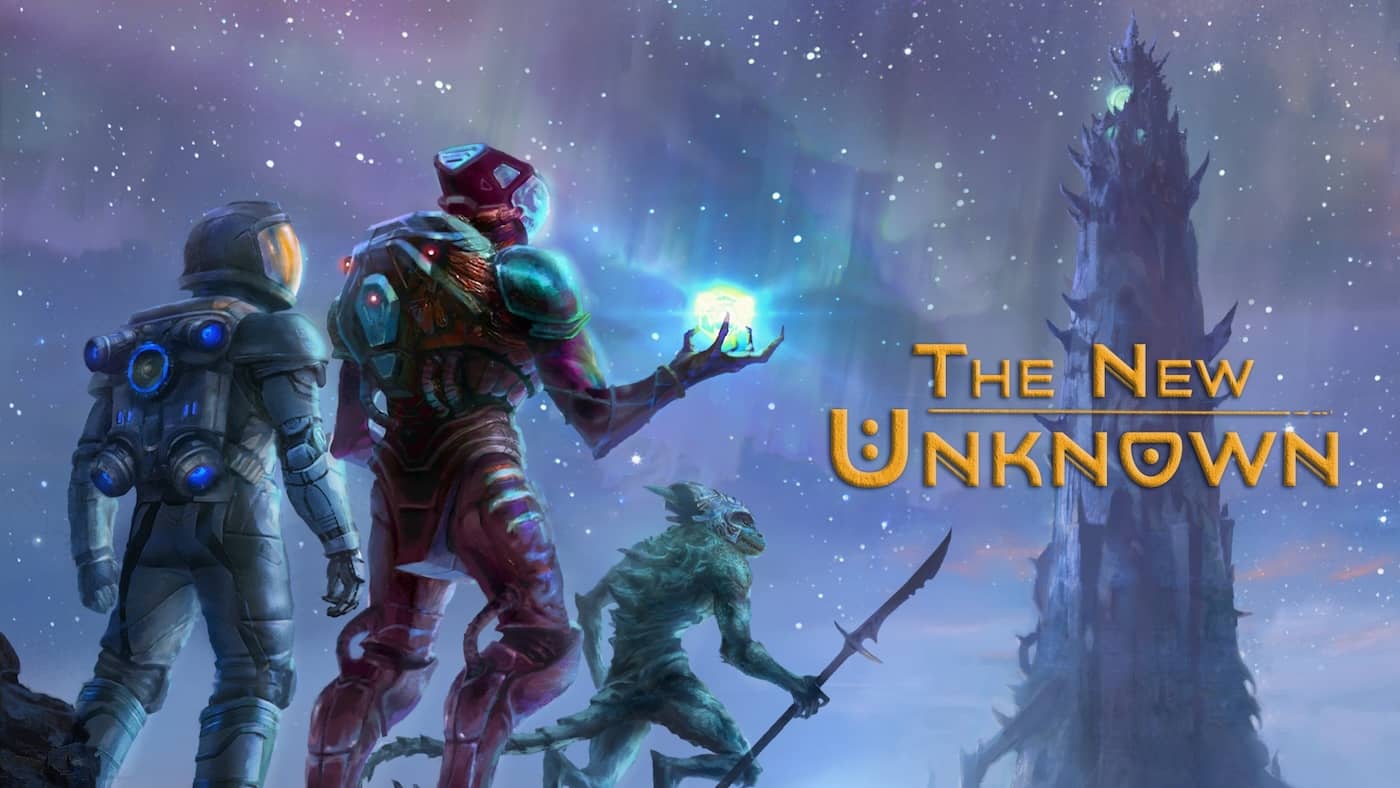
Like a rebel moon hiding behind a planet, The New Unknown has been difficult to fully see from a distance—its scale hinted at in playtests, its ambitions surfacing in fragments. So we sent someone to explore the terrain. Carlos Cisco—Pistolheart designer and Star Trek screenwriter—sat down with the three creators behind the project to map its edges and test its gravity.
What emerged from their conversation is something larger than a setting book, and more deliberate than a simple conversion: a full reimagining of what Daggerheart can hold when pushed beyond the horizon of fantasy. Built by a German trio with backgrounds spanning game design, screenwriting, and interactive media, The New Unknown blends retro sci-fi instincts with modern narrative systems, aiming not just to expand the game, but reframe it.
Cisco spoke with the team over Discord earlier this month about scope, systems, and the risks of building something this big in public. This interview has been edited for length and clarity.
Tell me a bit about who you are and how you came to gaming and game design.
FLO: I have a background in game design. I studied games and immersive media, and right now I'm getting my Masters in interactive media design. I played Daggerheart first in the beta together with Alex, and then we started, a bit more than a year ago, to develop The New Unknown.
CHRIS: I come from media and screenwriting and wrote some campaigns for a German role-playing system. I've been a TTRPG hobbyist for 25 years. Flo and I met through Alexander.
ALEXANDER: I came into game design around two years ago. I started doing homebrew when the first beta for Daggerheart dropped. And around that time, [we had] the first draft for TNU. It was in early development—it had a totally different scope and idea.
So you all started this back when Daggerheart was in beta...
ALEXANDER: Yes. The first idea, the first draft for doing sci-fi Daggerheart, came around two years ago, when Flo and I were playing in a D&D group. I fell in love with Daggerheart, so we switched mid-campaign from D&D. We finished the campaign in the beta rules.
After that, we wanted to do a sci-fi setting, and we started a Star Wars campaign in the Genesys system. Around two or three sessions in, Flo said, "I really miss rolling Hope and Fear dice." So we decided to convert the Star Wars group to Daggerheart, and [that was when] I first noticed how good Daggerheart is for narrative sci-fi.
CHRIS: Some of the story ideas going into The New Unknown are really much older, because Alexander came up with a world setting—how many years ago, Alexander?
ALEXANDER: Fifteen years ago.
CHRIS: So there are some cornerstones that have been in more or less a development phase for a much longer time.
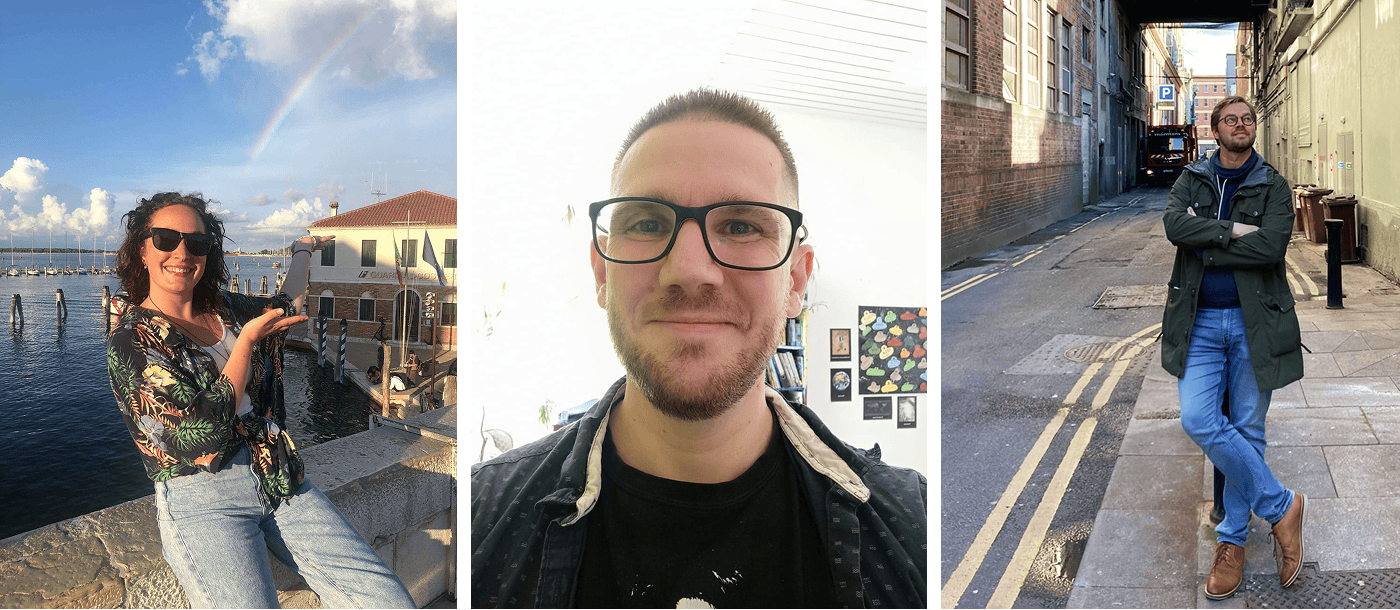
When you're doing something of this scope and ambition, it's good to bring in people who take their influences from a bunch of different places. You're forming a writer's room, in a sense, and you want to fill the gaps each other has. How have your different tastes coalesced into the playtest product you've released?
CHRIS: The different influences we have all collided in something that is mainly a human-centric setting. This was really important for us all. I think it's a bit retro sci-fi—that was an inspiration for us all. We came together and found we had a lot of agreement on what we wanted: human-centric, retro sci-fi rather than really high-tech and all clean. That helped us find a vision.
CARLOS: What are your influences, aside from the ones listed in the book?
CHRIS: I'm drawn more to characters than to big epic worlds. I like dark, atmospheric sci-fi: Event Horizon, the Alien franchise. It's interesting to see people in the vast darkness of space, disconnected from others. [Despite] all their technology, they are often dependent on themselves and their little crew. I like stories where you have a small group that has to fight for each other to survive.
FLO: I love that type of sci-fi as well—extreme situations the characters are put in. But I also really love Star Wars. The space opera stuff—heroic, happy ending sci-fi. All these different planets, locations, and cultures. And I'm a huge fan of science fantasy—Final Fantasy XV, for example.
ALEXANDER: I grew up on Star Wars but I also grew up with Star Trek. I love with all my heart the 2000s Battlestar Galactica. I think it's one of the best pieces of television ever written. I agree with Chris: sci-fi has, more than fantasy, a unique way to tell psychological and philosophical stories about where humanity as a whole is going.
And I'm a huge fan of Mass Effect, Destiny...I could ramble for 30 minutes.
CARLOS: [Raises hand] Long-time Destiny player, finally in recovery. I think the Final Shape was when I called it quits. Played since the first beta of Destiny 1.
ALEXANDER: Me too. I think I played since the first Alpha.
Talk about the choice to make the setting human-centric. Why only human as opposed to introducing aliens? You certainly use aliens as touchstone examples.
ALEXANDER: There will be aliens in The New Unknown. The first playtest features more human types, but we will have aliens.
[The challenge] in science fiction is you have stories like Battlestar Galactica where there are only humans or humanoid robots, but then you have Star Wars, where you have over a thousand different weird aliens...
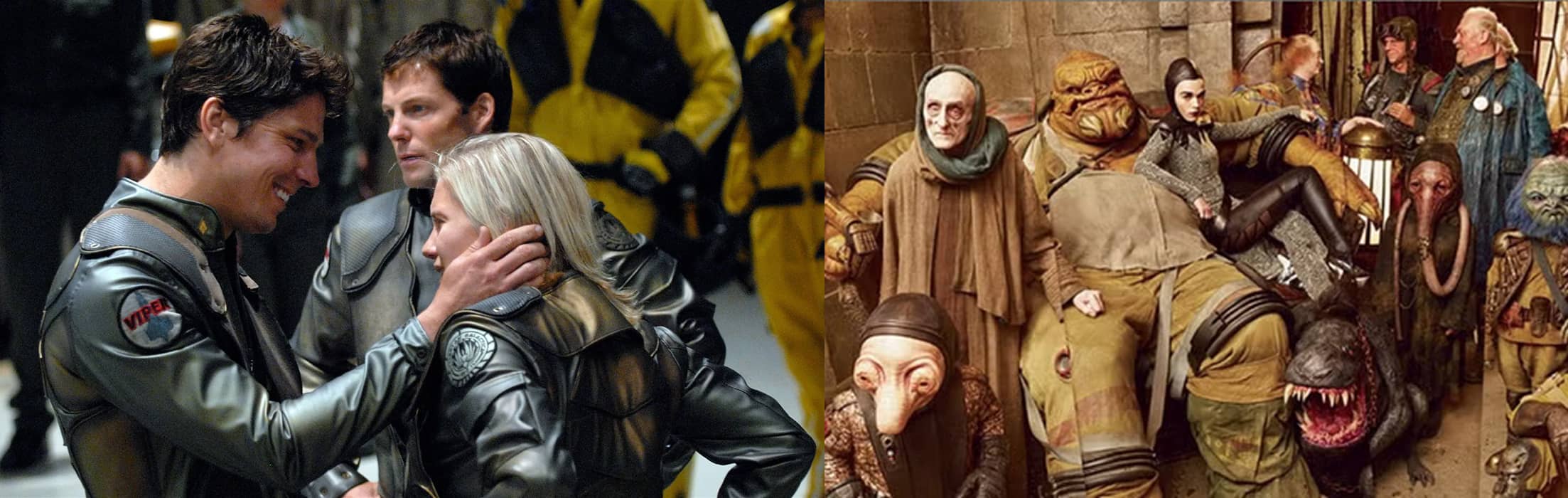
CHRIS: We were discussing how many different alien types we want to have and how many we need to present. Even though we want to tell human-centric stories, if you go into the unknown, there's room for a lot of aliens. We couldn't figure out how many to give [players]. Which were the most important? Do we need the Greys? Do we need a Wookiee? And when does it stop?
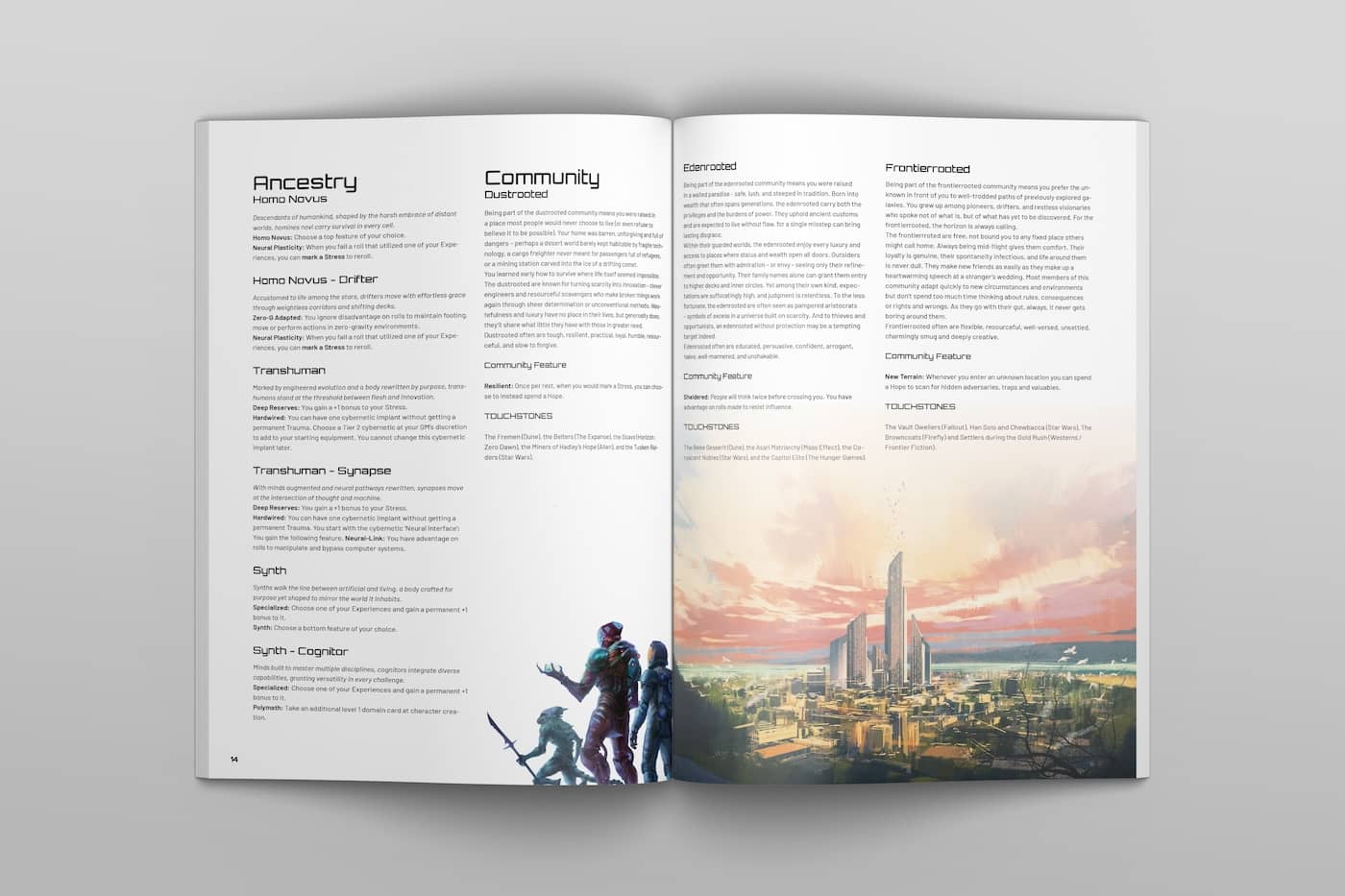
So Flo came up with the idea for the Endless Ancestry system: let players build their own Ancestries if they want. We'll provide examples and create new aliens, [but] when they come to a new place and want something completely different, give them the opportunity to meet exactly that.
ALEXANDER: In gameplay terms, the possible combinations for creating your own alien lie mechanically around 1,000+. And we will have around five to seven [core] aliens in the final book.
CARLOS: That's exciting. One of the [best] parts of any space game is what new and interesting people you're going to meet—and fight or make friends with.
ALEXANDER: On the other hand, we want to diversify humans. We don't just want one Ancestry called "human." We have different kinds. We have the classic human—the Daggerheart all-around character—but we also have the Homo Novus, the next-evolution type of human who was raised on another planet with different gravity or radiation and was altered by that. And we also have human-like Ancestries like the Synth, an android, or the Transhuman.
CARLOS: One of the core tenets of the Daggerheart Ancestry design is that there's no culture in the ancestry—it's always biological. I think you did a good job of honoring that. It feels like these are things that are part of the body, [whether it's] natural or synthetic biology.
CHRIS: Thank you.
One of the difficulties with sci-fi is you need to have an understanding of science to separate the science from the fiction. To get around this, you not only break down the Classes, but give media touchstones. Something familiar, like Ellen Ripley or Luke Skywalker. Talk about how you chose the Classes, because they're one of the things players interact with the most.
FLO: It was not just giving them distinct roles—like, yeah, you can be a pilot or a bounty hunter—but giving them a direction for their character to start, and abilities they can use and be creative with. We started with an approach of: how do we want the players to feel when they play The New Unknown? How can we give them the feeling of being in space—the feeling of wonder, the mystic feeling—and from there, which Classes fit?
ALEXANDER: It was important not to present jobs to people. We don't want to say: here's the pilot, soldier, [or] mercenary. Those are jobs, not Classes. We want unique identities, broad enough that people can implement their own ideas, but with the touchstones you mentioned; enough identity rooted in other media so that people can connect to them.
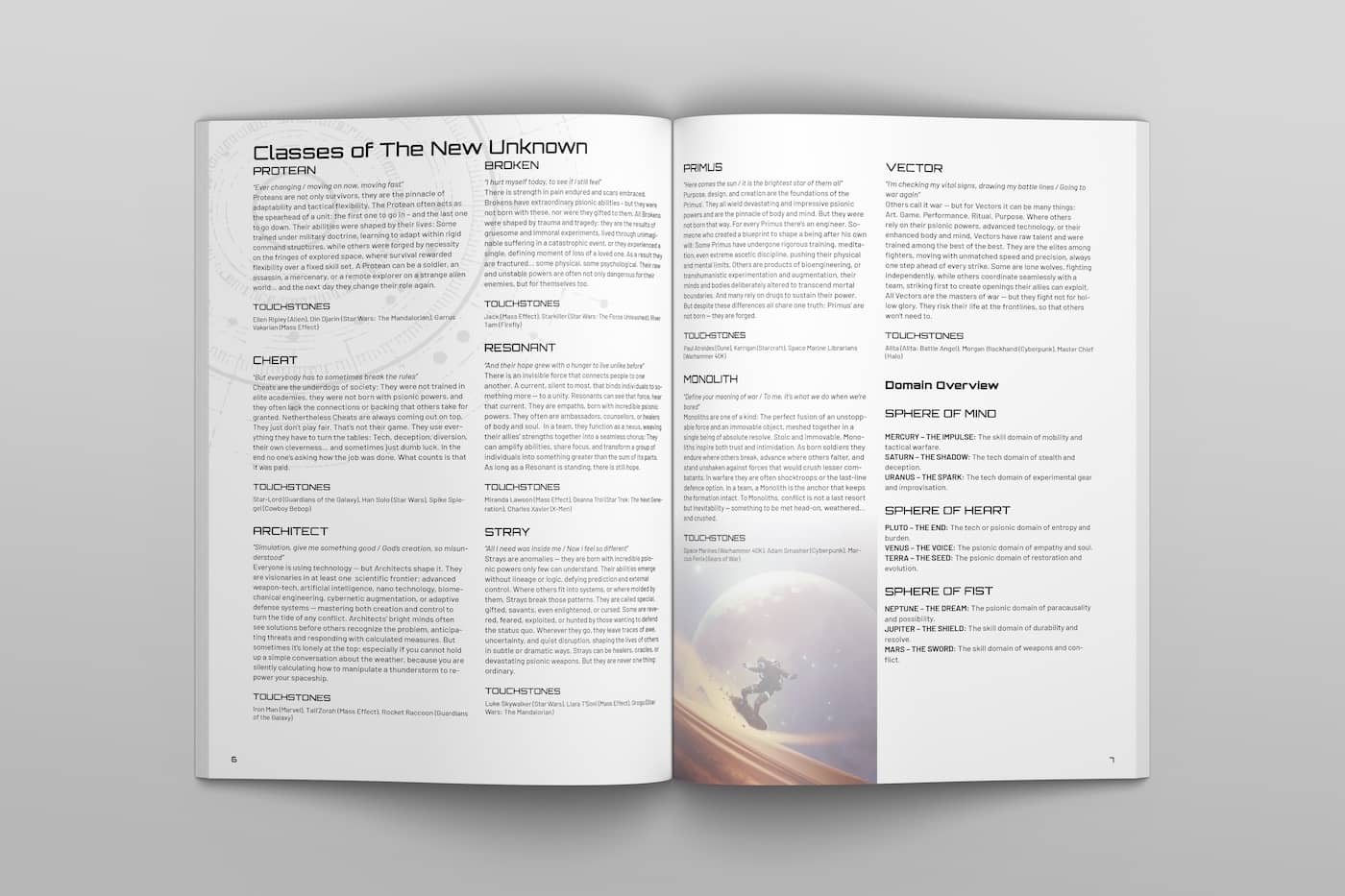
CARLOS: I like that even within those touchstones, there's so much variation. Ellen Ripley is not anything like Din Djarin, but they are definitely both Proteans. They're immediately identifiable, which you need with subclasses. I look at it and I'm like, "wish I'd done that for Pistolheart." Live and learn. Maybe for the book.
CHRIS: It's not done yet! There's still time.
Let's talk about the difference in rules. You change some basic vernacular, which is interesting. The Power Trait instead of Spellcasting Rate makes sense, because you're not necessarily casting spells in this future. Same with Trauma instead of Scars. What was your reasoning behind changes in vernacular that don't actually change the rules?
ALEXANDER: Trauma versus Scars is a good example. We want to give TNU a new language. [For instance,] I think "scar" is a wonderful term for a fantasy setting. You can picture a warrior who is scarred from all the battles in his life. But that's not what I see when I look at sci-fi. The traumas are much subtler. There's the possibility of emotional trauma, not physical trauma.
Regarding Power Traits versus Spellcasting—one of the difficulties in doing sci-fi is there are hard sci-fi settings where there is no psionic [abilities], no Force, no space magic. There's only technology. But other settings like Star Wars, Destiny, Mass Effect… these are more science fantasy than science fiction. So we want to give players the opportunity to do everything within our system. They just have to reflavor some psionic powers as tech, and [then] they can do their hard sci-fi setting within TNU.
CARLOS: Back to Trauma and Scars for a moment. In the future we've got stuff like bacta tanks, med beds. You're not leaving with literal scars anymore. You're fully restoring your body. That makes sense. And the Kinetic and Energy distinction—that clicks immediately.
ALEXANDER: Exactly.
Domain cards are interesting. You have some one-to-ones—the Engram cards are essentially Codex cards—but you have a really unique mechanic in the Sigil cards. It minimizes homework in terms of tracking: I use it, I flip the card, the next time I use it it's better.
ALEXANDER: One of the beauties of Daggerheart are the cards. We really wanted to use that physical aspect. So, you have something to do on your character sheet. You choose the [Sigil] card, and you can activate it without paying any additional costs. Or you can choose to pay [an] additional cost—which is hefty, because you have to mark an HP—but if you pay, you can flip the card and have the option to do a much more powerful effect later on in the game. [This forces you] to balance your own resources. It's a very high-risk, high-reward mechanic.
CARLOS: I love high-risk, high-reward classes, but not everybody does. What's the response been so far from playtesters?
ALEXANDER: Most were positive. [But] we want to diversify [so] different kinds of players feel at home within our system. We want this high-risk, high-reward playstyle, but we also have a tech domain which [relies on] micromanagement where you have to track another resource besides Hope and hit points and Stress. And we have a simple way of playing [using] a flip mechanic, which is limited to one Domain.
CARLOS: [So] you're priming players: some who like more crunch, others who may not.
CHRIS: Yes.
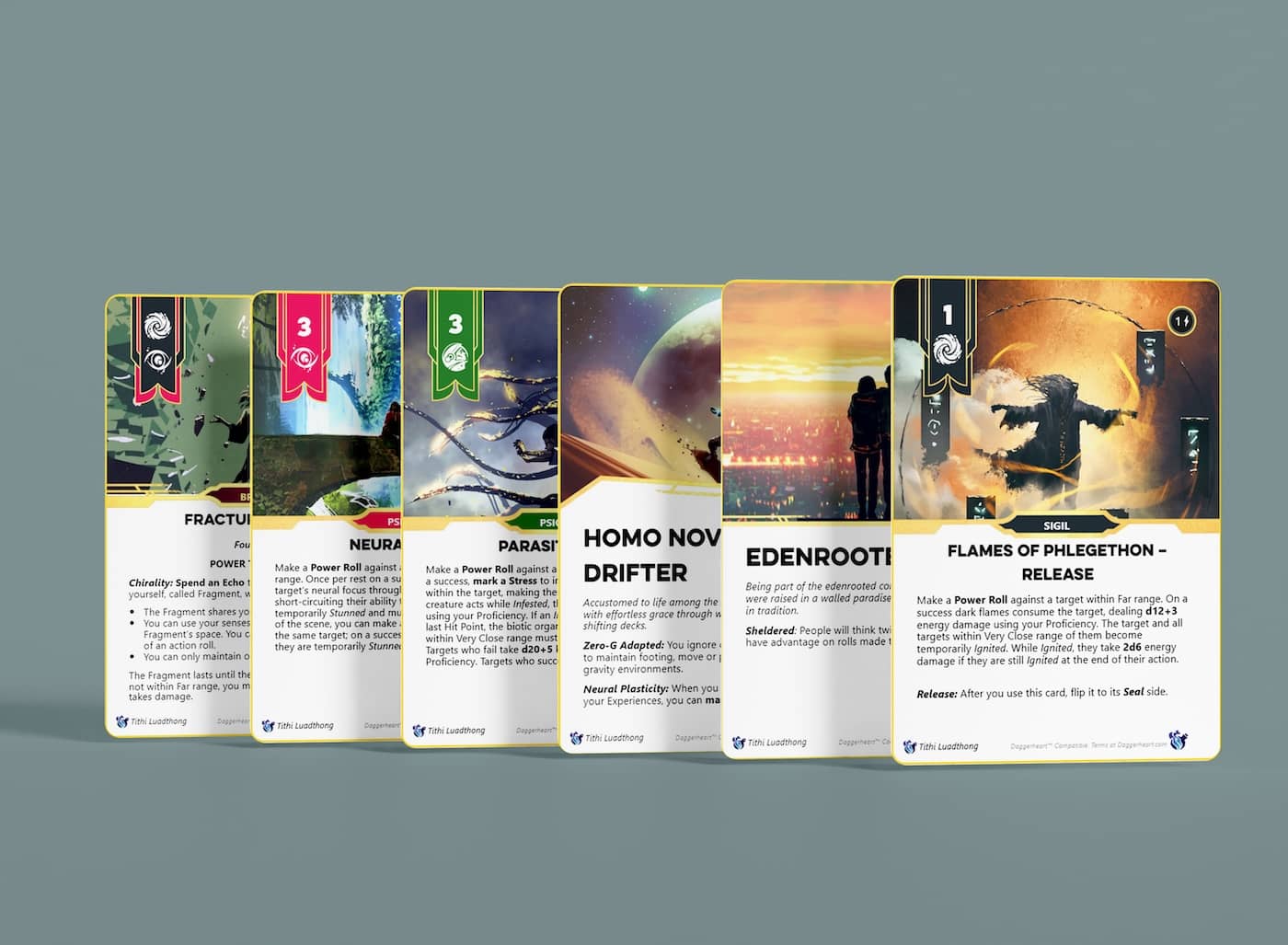
CARLOS: I have something similar in the design for Pistolheart's School of Gambling Wizard—a game where you're managing your cards [and] trying to get certain hands by the time you hit mastery.
ALEXANDER: It's such a cool idea.
CARLOS: It's like the Touched Domain cards, like Valor Touched, where if you have a full house—three Domain cards of one type and two of another—or a straight, or a flush—you get a host of bonuses.
ALEXANDER: It's what I meant when I said it's the physical aspect of the game. There are cards you can really play with, and I think Daggerheart as a whole has the option to grow the mechanics from there.
CARLOS: There are certain aspects in the core game that are underused and [ripe] for mining. Things that manipulate the vault a little bit more. That's not a mechanic that's widely interacted with.
ALEXANDER: We have a mechanic in the Pluto domain that references Hades and his wife Persephone, who goes into the underworld once a year and comes back and the different seasons are explained around this. In The New Unknown, this is a mechanic where you put cards in your vault, get a resource back, and get another bonus.
What has been your process for playtesting?
FLO: We have two types of playtests. People we directly ask for feedback, and our Patreon for everyone to test out and write us emails or comments. We have three playtests [running] and at the end there will be an evaluation of the data.
CARLOS: How are you collecting the data? I ask [on behalf of] people venturing into this space who have no clue how to playtest outside of their group. It [helps] to send our stuff out to be interpreted by other people because they're going to see holes we can't, because we've been deep in it for months, if not years.
CHRIS: We have two ways: publicly in the comments, and privately through email. We encourage everyone to tell us honestly what they think and especially what they don't like. And we want it to be public so others can jump in and say, "yes, exactly that, this is important to me too."
But People who don't want to share publicly can send us emails. [These] tend to be the long feedback reviews, which is really amazing. We have people already homebrewing and telling us what they did, so we can probably change it in the final product. We are in conversation with an active community, and this is what we wanted to achieve.
CARLOS: One thing I found success with was making Google Forms, because there are a lot of things you might have specific questions about—or even just saying, "Read this section and tell me if it makes sense." And if they can communicate it back to you, then you know you're doing your job right.
CHRIS: I love that.
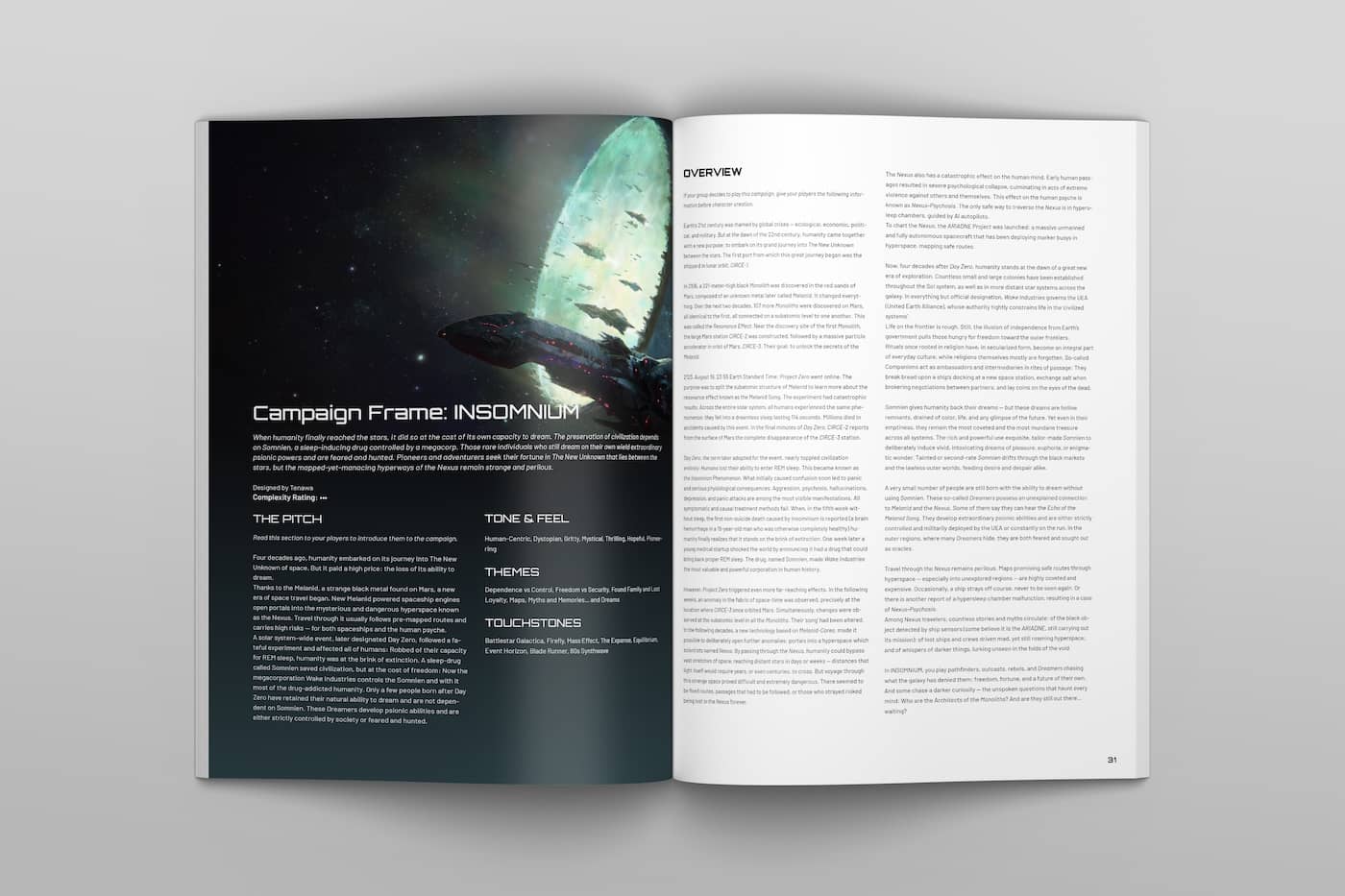
The New Unknown is really, really big, and this is your first foray into the space.
CHRIS: It's funny—we started out by saying, "let's do something small, let's just do a little conversion to space." [But] when we started talking about it in more detail, we couldn't let any of the details go. It grew quite a lot.
ALEXANDER: Our first codename for this project was Starheart. It was a simple sci-fi conversion of Daggerheart. As we continued our development, we reached a point where we were thinking "this has so much unique identity, this is not Starheart anymore." It was a new world. A new game rooted in Daggerheart and the Hope & Fear system. [That's when] the name The New Unknown came into it.
CARLOS: What is the full scope of the book? What's in the playtest versus what's coming?
ALEXANDER: The [full] scope is the same as the Daggerheart book—300 to 400 pages. We will have nine new Classes, nine new Domains, around 400 items, four campaign frames, and a new spaceship combat system.
What you see in the playtest is around a third. The first playtest showed an overview of the Classes. There will be at least two more playtests, and each one will have three Classes, three Ancestries, and three Communities.
CARLOS: Of the Classes not yet revealed, which ones are you most excited about?
CHRIS: For me it's easy: the Cheat. There's an actual system for cheating [where] you can influence your results. It's [a Class] that is convenient for players who don't want a lot of micromanagement or rulebook knowledge, but just want to play and concentrate on the role-playing aspects.
FLO: The Resonant. It's a socializer [who] connects the group through mechanics. It gives this ludonarrative harmony in game design, where the narrative part and the game mechanics work together. It connects everyone at the table through narrative and mechanics, and I love that.
ALEXANDER: I think it's the Protean, the most underrated Class right now. But I also love the Broken and the Resonant—they are two sides of one coin. The Resonant is a socializing character who connects the group on a game-mechanical level, [while] the Broken is a scarred or traumatized character who draws power from strength and trauma. I like them a lot.
What challenges have you faced doing something of this scope and scale? What are some things you've learned that you wish you knew beforehand?
ALEXANDER: For me personally, it was working in a team with three people. I had only done work on my own until now. In regards to the project, it's been a problem to say: no, stop! I have another Class, I could do more weapons, more Adversaries, a fifth campaign frame. To limit the scope. That's [been] difficult.
CHRIS: For me it was deciding to go public while we were still creating. I like a finished story, when we know exactly the polished end version. But on the other hand, we needed to know if what we were making would interest people. We didn't anticipate at all how quickly we grew a community with our Patreon and with the first Reddit post—that was really overwhelming to us all.
I'm a bit like a novelist [and] this is more of a role-playing approach. Develop things together with our community and see where their feedback takes us. The players don't do what the game master says! They have their own logic and ways to go, and you have to follow them, or at least a bit. It was not easy for me, but it was really rewarding.
FLO: That's one of the points for me too: community management, and having so many people looking forward to playing our game. It's not the first game I'm working on, [nor] the first project working with other creative people, so that was never a problem. But having this huge community that is so desperate to play what we created—it's a bit overwhelming sometimes.
CARLOS: Community building and management is one of the things I've struggled with personally. I do it fine over social media and through Reddit, but I haven't done any Patreon or Discord just because the thought of it exhausts me. The nice thing is that there's three of you, so you can split the load on a project this ambitious.
[Sounds of agreement]
What are your hopes for the book? Not just fully funding, but all the way down the line?
ALEXANDER: I personally hope that TNU is something that will stay in the community. We really hope to add to the first book—more supplements, more campaign frames, more spaceship combat. This should be the first peak into The New Unknown, not the last one.
FLO: I'm just really hoping that people can use our system to build their own worlds at the tables, and that we get to hear about them.
CHRIS: The Daggerheart community is a really wonderful place where homebrewing is really a focus. If we can create something that is a starting point for other creators, then I'd be really happy. We received a lot of support during our development journey, and this is something I hope can go both ways. We present something for people that they can use to extend and to build on.
CARLOS: When does the Kickstarter go live?
CHRIS: The 28th of April.
CARLOS: I wish you the best of luck in funding. I'm sure we'll be talking soon.
CHRIS: We appreciate you having us. Thank you very much.
Carlos Cisco is a screenwriter and game designer. His credits include Paramount's Star Trek: Discovery, Darrington Press's Daggerheart, and MCDM’s Arcadia and Flee, Mortals! He’s the author of Colossus of the Drylands, and the best-selling western supplement Pistolheart, which he independently produced.