Panic Attack
Three friends hacked Daggerheart to make the horror AP of the year. Now they have to do it again.
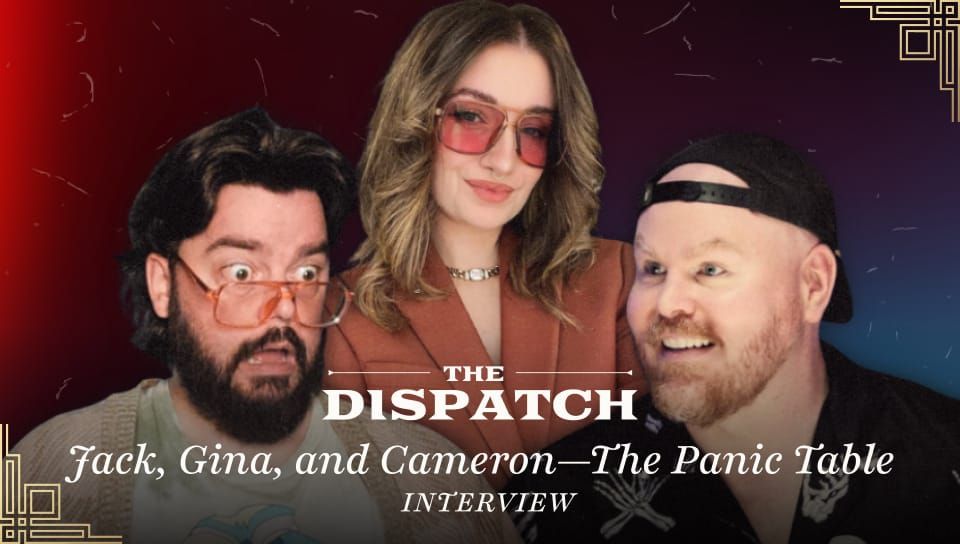
The ENNIE-nominated horror hit How’s My Driving? seems like something Blumhouse might produce: a subversive, genre-bending slick-pic made on a dollar-store budget with a cast of unknowns.
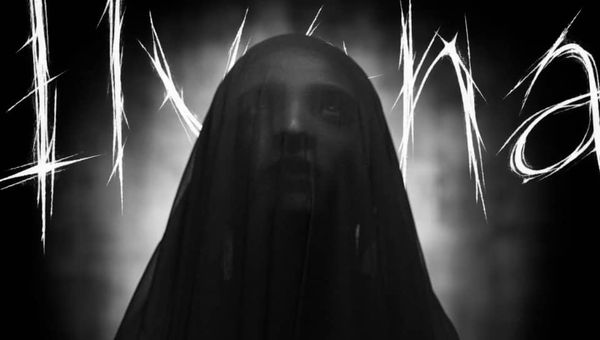
Instead, it was the work of The Panic Table, a trio of actual play collaborators—GM and producer Cameron Strittmatter, game designer Jack Panic, and actor Gina Susanna—who figured out how to hack Daggerheart’s Hope & Fear system into the chassis of a propulsive slasher flick, an AP set on a dark highway in Oklahoma where a faceless Bag Man relentlessly pursues three final girls, Susanna among them.
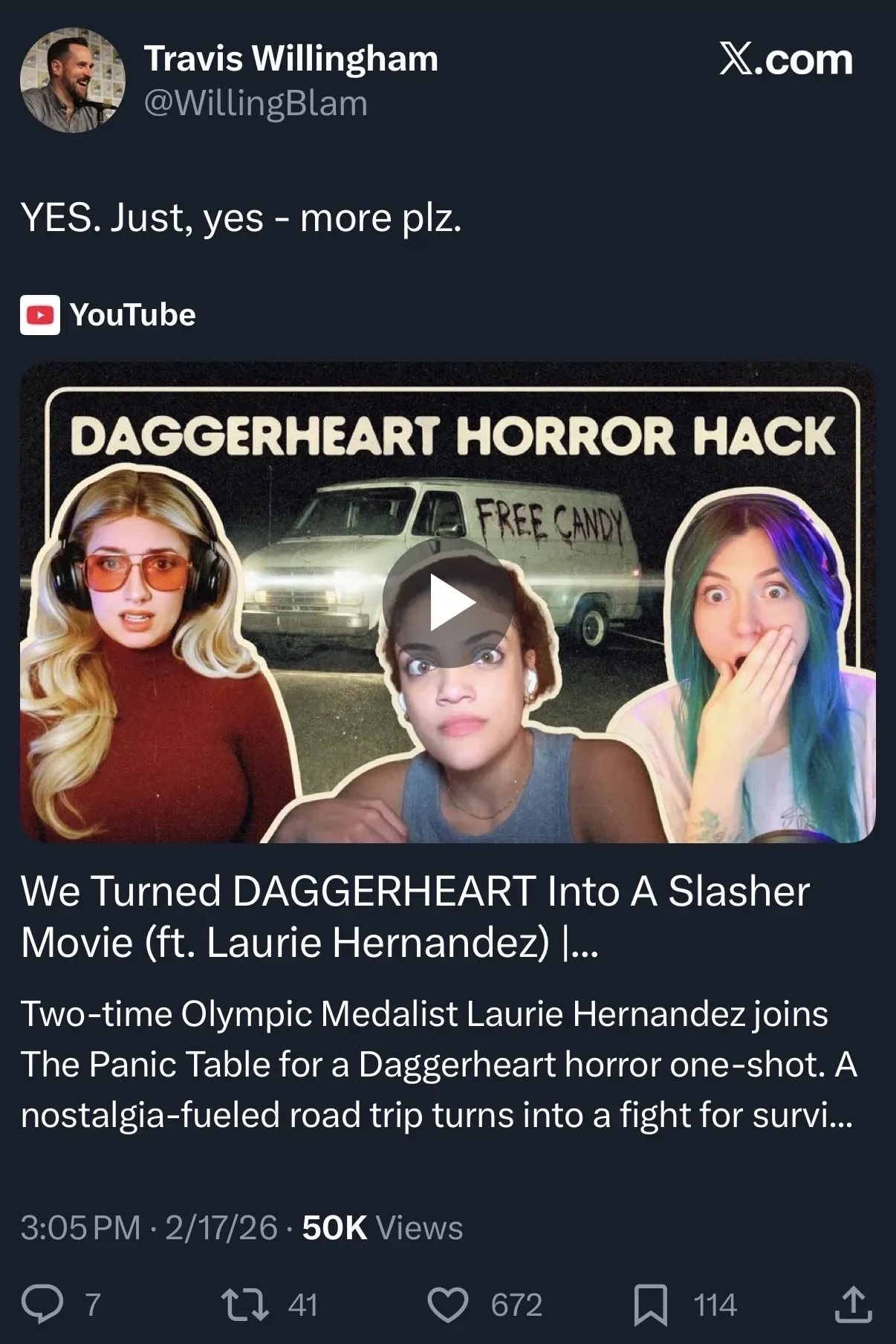
HMD quickly became a hit, building views week over week until it caught the attention of Critical Role’s CEO Travis Willingham, who took to the socials to beg for more. Now, months after their debut, the trio and their accomplices are back with a sequel—How’s My Driving 2: Thank You for Shopping—and have to do it all over again: make a single two-hour-long actual play feel like a Friday-night fright pic you breathlessly sell to your friends (and maybe even turn a scrappy experiment into something with a future on Beacon, CR’s streaming service).
With the sequel launching, we sat Strittmatter, Panic, and Susanna down for a chat about hacking Daggerheart for horror, the Travis moment, and becoming the next Blumhouse. This interview was edited for clarity and length.
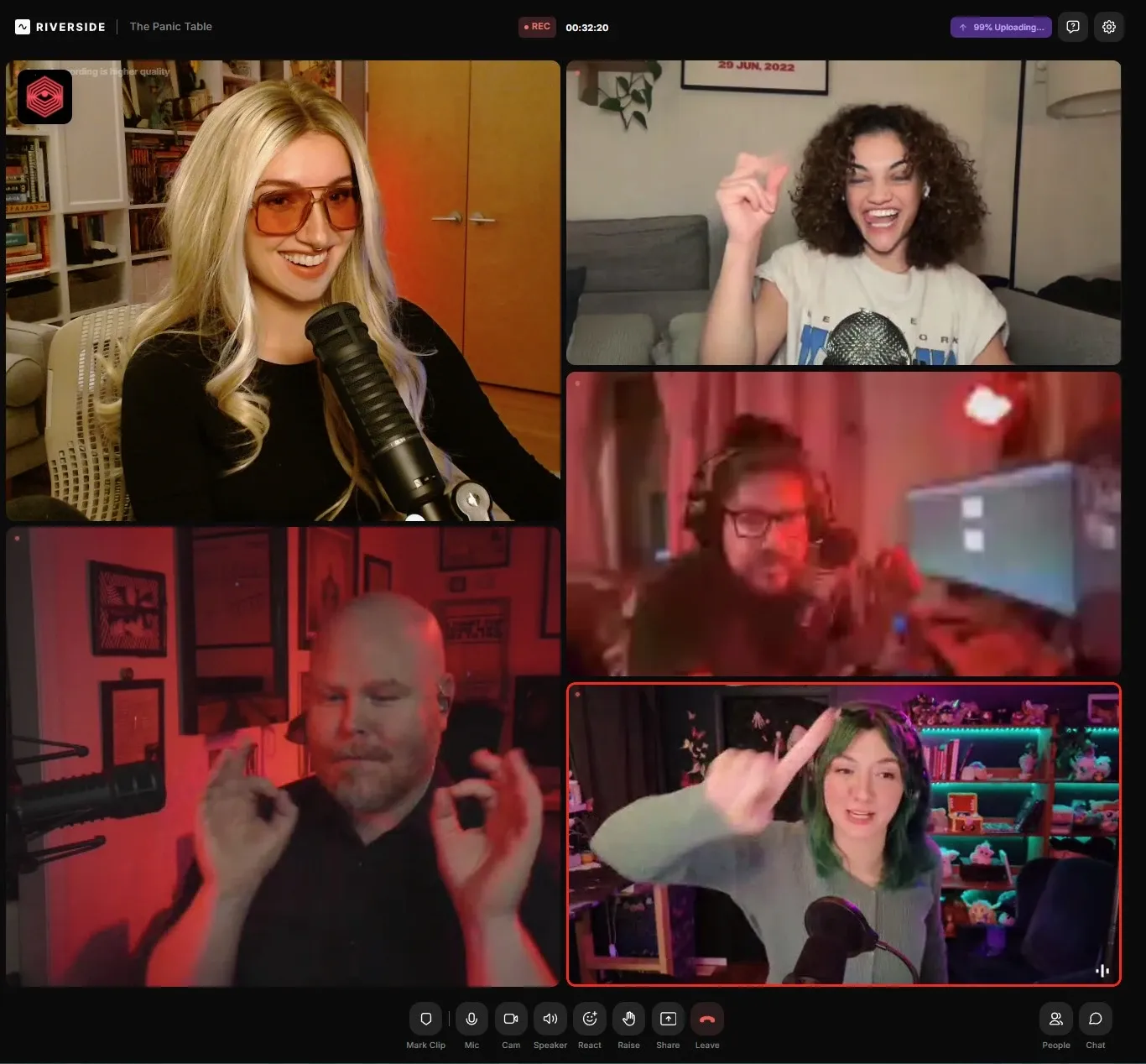
GINA: Just my full-throated laughter to start us off.
JACK: Do it again.
CAMERON: So here's the context of what's going on. Henry at The Dispatch reached out and said, “Let’s do an interview. But I think you’re all cooler and more fun than I—so here are the questions. Talk amongst yourselves."
JACK: The three of us have gathered here on the moors of Scotland to discuss How's My Driving, Volume One.
GINA: I'm also me. Just a room full of me's.
JACK: (re: Cameron's intro) I think you’re using your hosting voice.
GINA: This is his natural state.
CAMERON: I don't know who this is… like, why am I performing? This is just a conversation for ourselves.
GINA: Let's start with the first question: how did this project come together? How do we all know each other?
CAMERON: I think I speak for the group when I say the government called and was like, "We need you, Cameron. Now. It's me, Donald Glover."
GINA: The big red phone rang.
JACK: Cameron is the only reason I have a social life outside of a very small bubble of internet people, mostly game designers. So that's how the three of us met. I ran a game for you first, Gina? The Mothership one?
GINA: Yeah. You ran "How to Train Your Dog."
CAMERON: I have no memory of this. Is there evidence of it online?
GINA: There is. We have clips. It's wonderful.
CAMERON: [As for] Jack and I—I was on TikTok a few years ago and caught Dungeon Club's scent on the wind, like a shark senses blood. I immediately started emulating it, and then you noticed I was emulating it, and you were like, "That's cool." I think that was the beginning of the bromance. That was when you were like, "Get in, loser, we should go shopping."
JACK: You sent me some promo stuff and I was like, "Cool, I'm a fancy boy now, people are sending me things."
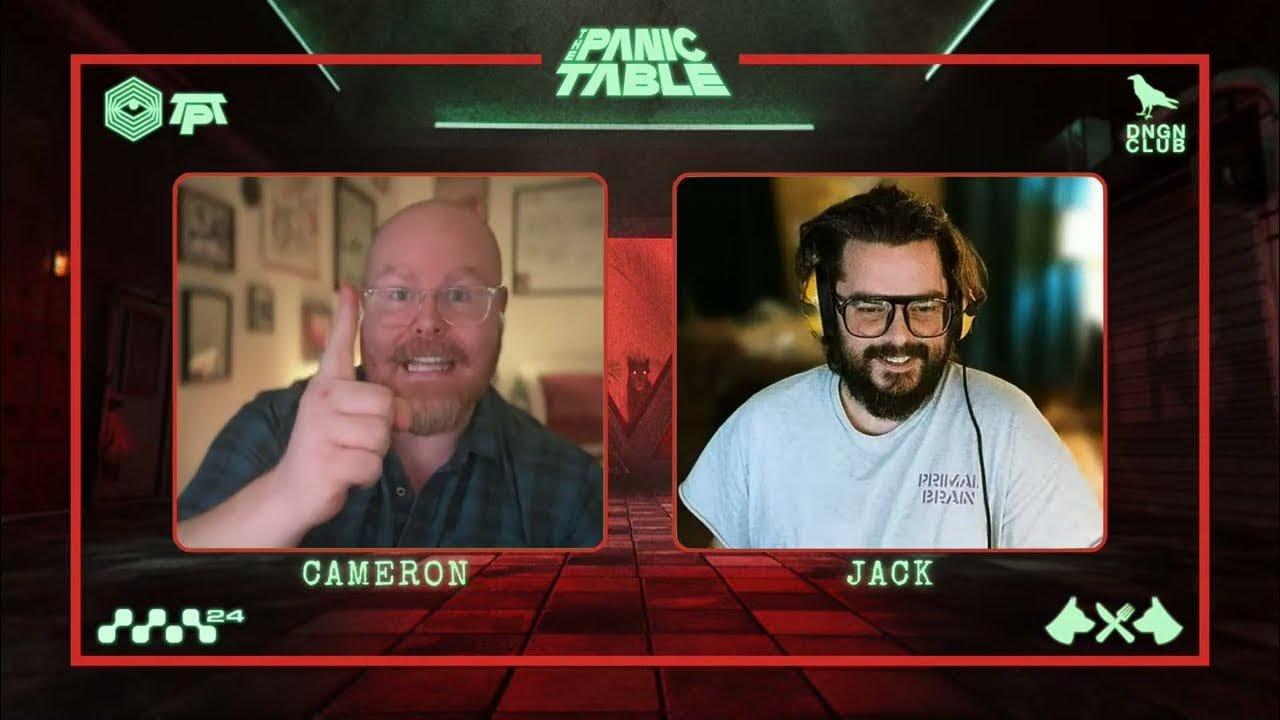
CAMERON: Jack, while you have other things you're supposed to be doing, you design new exciting games.
JACK: I do a fresh, free thing every month as part of my Patreon—either a full game, supplements, or a bunch of little things. The idea is that pays for me to have the space to practice. How's My Driving was my October game of last year. It started as a joke with my friend about Daggerheart as a horror game—mostly just like, what would we call it? Horror Heart? Dark Heart? Darker Heart?
CAMERON: I'm a fan of Darker Heart.
JACK: The concept was: this game has real legs as a horror game if Hope diminishes as a core mechanic, because then the math gets tilted toward lower success rates and higher amounts of fear being generated. As you lose hope, the fear becomes more present—and that's really good genre emulation. The game was actually going to be called The Last Resort first.
CAMERON: Ooh, that's good too. File that away.
JACK: It was going to be very Silent Hill-inspired. And then I saw a "How's My Driving" sticker somewhere—maybe on the road—and I was like, well, that's a better title. So I just changed the game completely. I just rewrote it.
GINA: Just redid it.
CAMERON: It's an iterative process. Jack is cranking out a game on a monthly basis and he has this amazing ability to make something and move on.
GINA: And they're always good. That's the thing.
CAMERON: That's not true, there's some bad ones.
JACK: Name one.
CAMERON: There was the one about stomping baby ducks.
JACK: That's not a real game, Cameron.
CAMERON: Damn it. Jack, I can't name a single bad one. Well, name one, you bastard!
JACK: No, you're right. They're all very good.
CAMERON: Jack, this one I'm gonna pitch to you. It's a nice softball: why Daggerheart, given that HMD is built to run on its own? How did you approach the hacks?
JACK: To me as a designer, what really made Daggerheart sing is that there are all these systems that interlock to create a very cinematic experience—lots of tactical crunch, interesting things to do. There's also a lot of intentional white space in the design. My guess would be that in the design intent, they wanted to make a game that would capitalize on people who played D&D and their proclivity to make things for their game. They wanted to build something very hackable.
How's My Driving is so far from the actual rules of Daggerheart that I didn't actually have to include any legal text. I messaged Spencer and he said, "You're good." So I really just started with that core concept and whittled everything down. It's just a matter of applying genre. You don't need things like hit points in a slasher. You're not watching Halloween to see Jamie Lee Curtis face off one-on-one with Michael Myers.
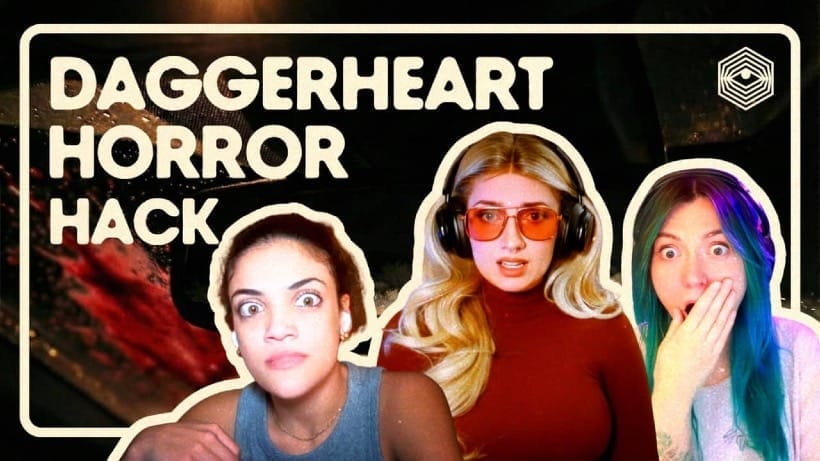
CAMERON: And Gina, you've experienced this firsthand—it's unimportant if the killer has hit points. It kills. That's what it does. That's the elegance.
GINA: The action is the tension. The action is doing everything you can to avoid the Bag Man, and his one move is kill. Everything you're doing is based around: don't let that happen.
JACK: Well, if you want the battle to be where the action is—but that's not what's happening when you're being chased by a psycho killer. What can I say.
CAMERON: And that's where the duality dice really sparkle. Coming from a Mothership background, sometimes it's like, okay, how do we fail forward? What's something other than "you miss with the gunshot"? Daggerheart cleanly provides a flow where you're never being batted for failing. It just clicks so nicely for a kill game. Gina, have you played Daggerheart proper?
GINA: Yeah, with some home groups. I really like the narrative aspect—the ability to make scenes the way you want them to be. Not railroading, but using what you like about playing the game. It has a much more back-and-forth, collaborative nature than crunch and mechanics and whittling down hit points.
I write for Pathfinder, so that's the crunchiest one: how many actions do I have, how many feet of movement, how many hit points. What I really like about How's My Driving is the ability to use my favorite part of horror—what you hope doesn't happen. That's more terror, right? Terror is what you hope not to see. Horror is what you are seeing. The anticipation of it all.
CAMERON: The Anticipation. (to Jack) Can I give you a compliment? I think Daggerheart does character building so well—it's a game in and of itself just to get going. You captured that essence and still made it completely your own thing. You preserved the ethos of Daggerheart.
JACK: The things about it that work for me continue to make me think about it despite the things I wasn't into. By the time it got to print, they'd basically taken out the combat structure I didn't like from the alpha and made it much more freeform. Not having restrictions on who goes when makes for a much more cinematic experience. And "cinematic" gets thrown around a lot, but for me, cinematic means everything we need to know about the situation is in frame and conveyed directly to us as audience members. When you're playing a game, you're the writer, the director, and the audience member. We're audience members for each other.
GINA: If we're talking dedication to vibe—thoughts on having just three players? Would a bigger group kill the intensity? How did you approach casting and chemistry?
CAMERON: Frankly, there was no casting process. Gina and I have been friends for several years and I already know her favorite thing to do is pretend to be in a terrible situation for as long as possible, and then access her deepest, darkest feelings and throw them out through a character.
GINA: I didn't cry in this one, though. Aren't you proud of me?
CAMERON: You didn't cry yet. I'm withholding. I'm cruel.
JACK: After he's been doing nothing but giving compliments for twenty minutes. He's so withholding.
CAMERON: (Here are my notes for both of you on areas you can improve—my SWOT analysis.) Anne [Monteverdi] was a given. I had the pleasure of participating in an AP she and Em Carlson [Blackwater D&D] put together, and even before that, Anne gets horror. She was like, "I medically cannot do this this hard again. It zonked me. I had too much fun and now I am very tired."
And I just knew Gina would be perfect because Gina loves to suffer on camera as much as possible. When you have the character archetype Loverboy—that was almost a given. You were always planning on being a cinnamon roll. A born final girl.
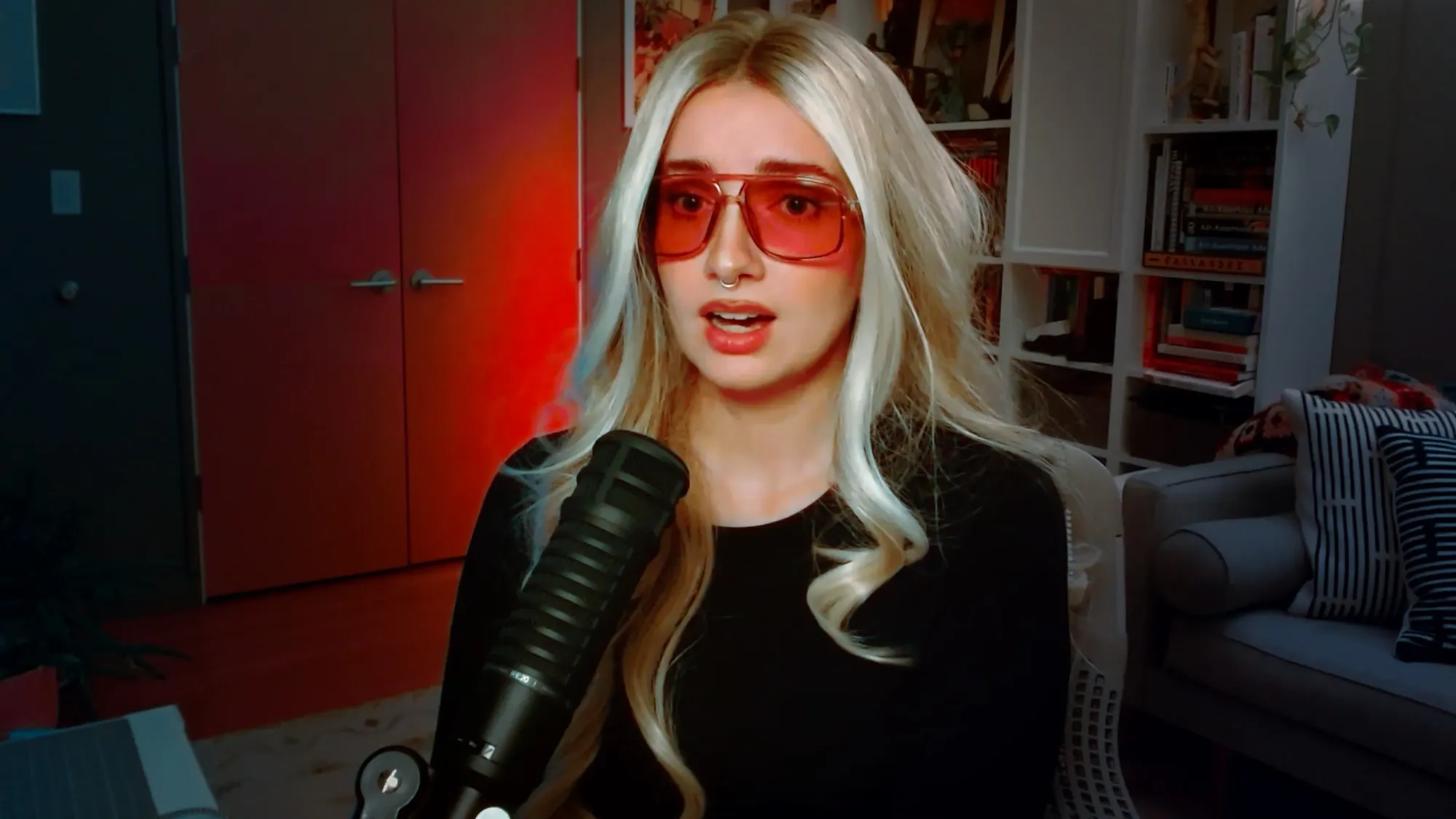
GINA: Shucks.
CAMERON: Laurie Hernandez—I had the pleasure of working with her in a Many Sided Media game. I got to play a biblically accurate angel, she was the Loch Ness monster, and it was laundry day at Yezeba's. Had a hoot. Had not Googled her. I invited her to play How's My Driving. Then, like weeks before we were slated to record, I just popped her in the old Google dot com and did a triple backflip.
JACK: Thank God you didn't. You probably would have fumbled that interaction if you'd known.
CAMERON: Laurie Hernandez of Dancing with the Stars, two-time gold medal Olympic winner. And also: soon to be on Broadway. So, yeah. "What is this? Is this something I should be aware of?" Yes.
JACK: It ended up being perfect. I didn't have this conversation—I'm not involved with Cameron's writing process or production process. But it is so interesting that you ended up with an all-femme, all-queer cast, because when I created the Bag Man, I was specifically referencing this guy on TikTok and Instagram—the Terrible Dogfish—who does high-production, hot thirst traps of ghost men. There's something very female-gaze about it. What I wanted the Bag Man to be was a pure embodiment of toxic manliness constant in the genre. Then I wanted to package him as being cast in the female gaze specifically. Like, an emphasis on his hands...
CAMERON: (under breath) Those broad shoulders.
JACK: Men would want to look like the person under that bag, but the way the camera focuses on him is more... we're not watching him show off his abs. There are subtle things about him that are supposed to make him attractive. So it's super fun that the composition of the cast ended up being really, really great.
GINA: Cameron, you're filmed on a side view, looking away from camera. The question is: was this a deliberate choice to seem detached, to make viewers feel like they're watching from the roadside, unable to help?
CAMERON: I love that question. I love the insight. And I completely agree on its effect. My answer is no. I wasn't thinking about that at all. I just liked how I looked that afternoon.
(pause)
It is now canonical. I will own the ethos and the praxis behind having that impersonal... yeah. It works.
GINA: How did this production differ from or evolve from your earlier projects? What might you take forward?
CAMERON: Right. How's My Driving has been the single most well-received thing we've ever made, and it was a Zoom call recording. I'm extremely pleasantly surprised by it. It was made with pure love by a lot of people who really loved what they were doing.
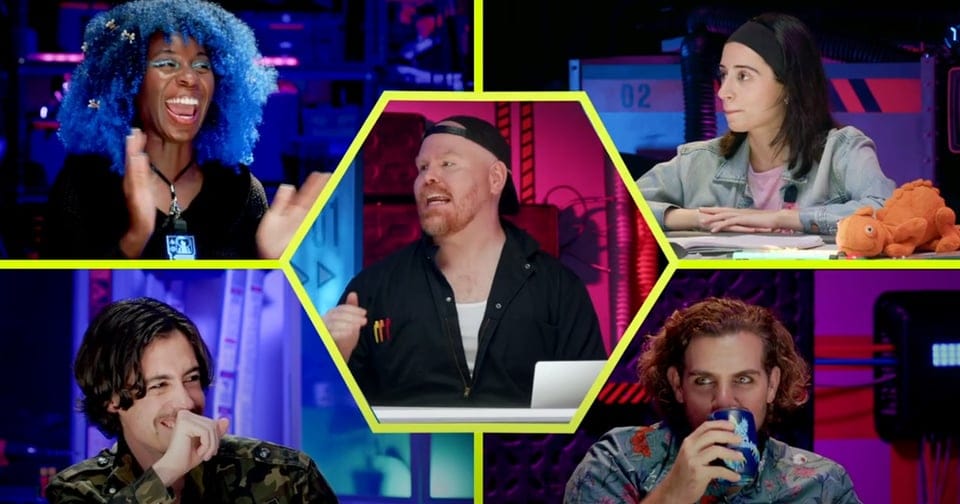
JACK: It went against some of your original ethos, though. When we first met, you wanted to show value with Unaccompanied Miners—you wanted to have a live show. The standards set by highly produced shows are perceived by the majority of the fandom as the real way to play tabletop games. And we've had many conversations where I was like, "Dude, you're gonna have to do some Zoom call games."
CAMERON: I think the format lent itself to the genre and trope of what we were doing. Having that lo-fi approach—it's not expensive equipment, it's attainable, it's budget. It's a slasher movie. It's one made for under a quarter million dollars in the 70s. Very proletarian. A people's movie. And I also—I don't think the cameras have to be nice, I don't think the lighting has to be impeccable, but I am a super snob about what APs look like. If your camera is shaky and someone's sitting on their messy bed and it's not diegetic to what they're doing—take a minute. Iron the towel you've hung behind your head.
GINA: That's a separate interview.
CAMERON: Yeah, I'll spiral. But yeah—How's My Driving, we spent maybe a week in pre-production. Unaccompanied Miners, we spent four months at least.
JACK: And it looks like it. I mean, the quality is there. But you wouldn't have started here until you did the other things. It's just part of it.
JACK: And to the genre—you pick the project to suit the medium. In a road trip game, you're all sitting next to each other. It would just be shoulder shots anyway if it was a movie.
GINA: What are you seeing in terms of momentum?
CAMERON: We're about six weeks out from dropping and it's just now starting to slow. We're still getting a few hundred watches a day. To put it in perspective: our most-watched episode of Unaccompanied Miners took two years to get into the tens of thousands across the whole thing. To do all of that in six weeks, as we approach 10K views at the time of this interview—it's so hard to ask for people's time. And whenever you make an AP, you are making a value assessment that what you're doing is better than how that person was going to spend their Saturday night watching regular TV, or the four-and-a-half-hour marriage engagement that is Critical Role. Attempting to disrupt that is tricky. Momentum was crazy. It is starting to slow—just now—like a flan in a cupboard.
JACK: Still doing views. I check it pretty religiously.
CAMERON: I would say the biggest reason this is doing well is Jack's design of the game itself—but also, when you think Daggerheart, you're like, okay, so it's like D&D. And to see three women in a van running from a serial killer in the midst of elves and tieflings and broadswords is algorithm magic. That's a fresh offering.
And then there's the Lauri factor.
JACK: Lauri not only is a joy to watch—people care about what she's doing.
CAMERON: I added her to the project on Instagram, saw that Lauri had 1.1 million followers, and then gave that a click. And then I was like: hmm. That's unusual.
JACK: What's going on here?
CAMERON: I would not have banked on Travis Willingham posting a tweet about it. Did it change anything tangible? Yes. If you look at the graph of views, we were doing pretty good. And then there is a vertical line of several thousand views just in one night. Where normally it's like a nice, pleasant, upward slope—if you're doing your job right—this was just a straight-up shot in like two hours.
GINA: Thanks, Travis!
GINA: There's been talk of The Panic Table being the Blumhouse of AP—Ryan Murphy, American Horror Story, that kind of thing. Is there a vision for what The Panic Table becomes?
CAMERON: I can't imagine a reality where I'm not obsessed by curating, collecting, and telling good horror stories– much to my wife and loved ones' dismay. The vision was always a production company cranking out horror material as hard and as esoterically as we possibly can. As we grow, hopefully that looks like several verticals—APs, TTRPG material, podcasts, yes; but also books, film, television, and cool adjacent products. One of my favorite recent questions has been "Plastic Bag Man plushie: when?" And figuring that out together is thrilling for me.
GINA: That kind of goes into Henry’s question about Critical Role—they just hired a Beacon exec, they're building toward a Dropout model. Horror anthology seems like an obvious fit. Are you having those conversations?
CAMERON: Moments after we published How's My Driving, Spencer and Rowan were like, "Hey—you wanna chat?" And so we started having those initial conversations about what the heck we're up to as The Panic Table. It's been exciting and validating—obviously, because they're freaking Darrington. But it's also cool because I've known and been peripheral friends with Spencer and Rowan just from bumping into them at Gen Con and PAX, where I simply knew them as extremely cool hangs. Now having businessy reasons to engage, and for them to be enthusiastic about us... Normally it's one-way, right? They've made amazing things. So now for them to now say, "Also, your things are cool," is a real treat.
JACK: Everyone at Darrington I've interacted with is already fans of games and of the space. They're natives to it. There's nothing that we don't gain from being fans of each other, especially when things are cool.
CAMERON: That's the pull quote, Henry.
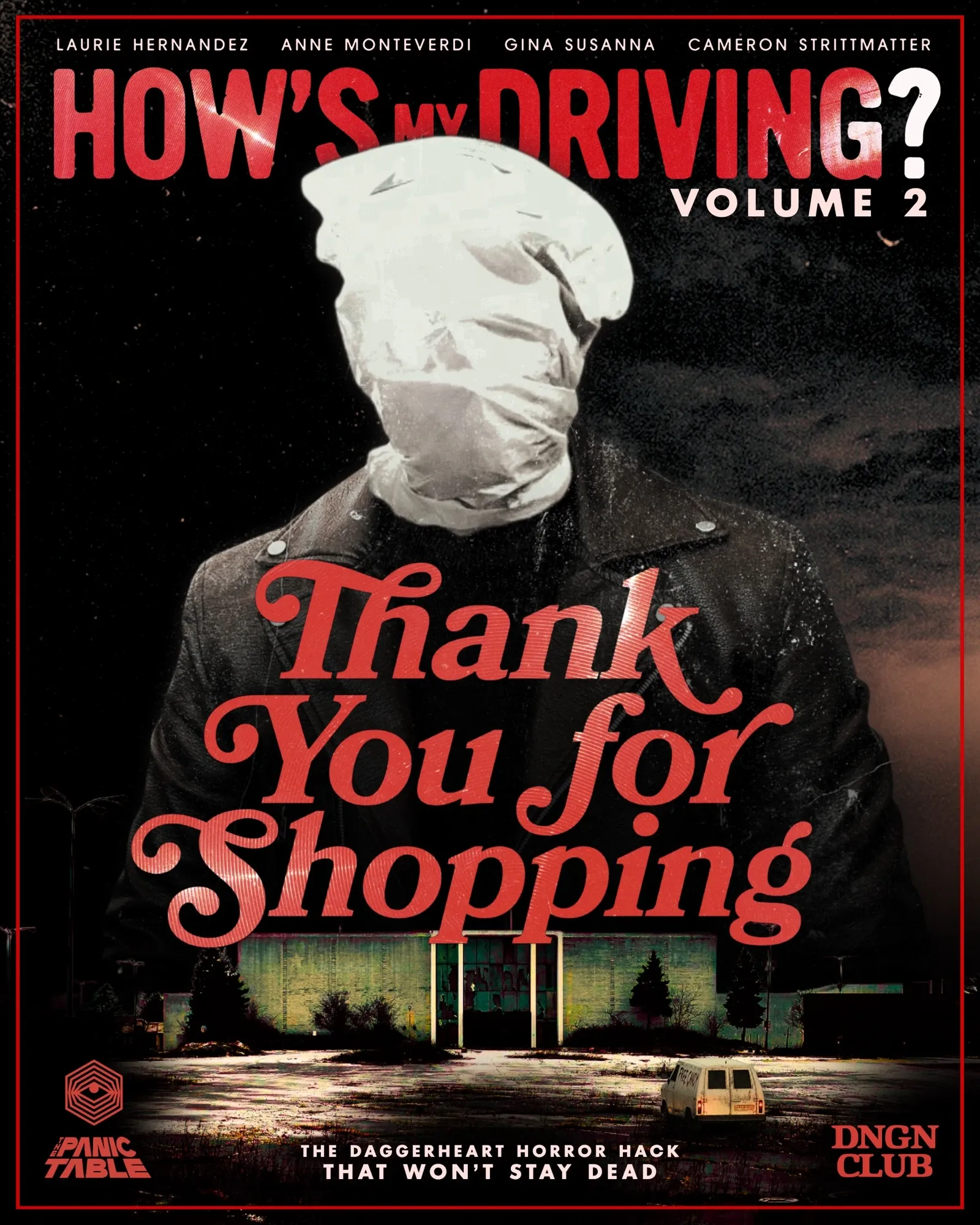
CAMERON: By the time this comes out, I think it will have already leaked that we've already started making How's My Driving Volume II: Thank You for Shopping. The second episode has been recorded. It went from kind of a trudge to the single most insane turn of events I could have imagined in a night. I was like, did I not prepare for this correctly? Is the talent bored with me? And then we just took a hard left at the lights.
JACK: You gotta make stuff if it's in you. For me, it's not an option to not make the stuff. Not making the stuff made me a very sad person. I've been able to completely turn my life around because I let myself be as invested in making games and pursuing my art. I'm literally healthier for it. I don't drink anymore. As long as you keep yourself focused on what is artful, you can't go wrong.
CAMERON: Yeah, baby.
CAMERON: Most APs are TV melodrama that you get hooked on with players you fall in love with. True or false?
GINA: That's a "yes, and…" The things that make stories engaging and important are the relationships you form both with the characters in the story and the way that impacts the relationship you have with yourself. These stories aren't just—I'm watching these characters engage with each other. The stories are how you feel as you're watching. Whether that's creativity sparked in someone who wants to design a game, or someone who sees people they can relate to playing together. There was a comment on our YouTube saying they loved watching it because it felt like they were watching their friends play spooky games with them. That's the idea. These things are always, first and foremost, about relationships and connection.
CAMERON: It's a joy to hit up Jack every single day and be like, "Jack, we should make new things. What do you think of this crazy idea?"
GINA: I do that to Jack all the time. "Jack, when are we going to play another game?"
GINA: What other projects are in development? How do you think about your place in the evolving Daggerheart or actual play ecosystem?
CAMERON: We're doing Bureau of Chronological Affairs—that's on the Daggerheart front and I'm really excited to dip a toe in that pool. And then Gina and I are developing a really—it's a slice of life game called Stiff Peaks, in which you play aroused bakers in Switzerland who live in a small Christmas village and are falling in love with each other, but have to save Christmas while also consensually making a bunch of small cakes. It's sort of an erotic thriller. I want to set that aside completely because that's not what Gina is hinting at even a little bit.
GINA: That's not—but it's delightful, and it's Stiff Peaks coming soon.
CAMERON: We're also launching a podcast later this year called Acceptable Losses—sci-fi horror in close quarters. Audio only. I'm excited to explore a West Marches approach to Mothership in the Unaccompanied Miners setting, but in a very adults-only exploration of horror, of intimacy, of sex and violence. We just dropped our first advertisement for that in Mothership's Mega Damage Vol. 1.
GINA: Cameron's skill as an audio editor, as a sound designer, as a general vibe creator is unmatched. Unmatched.
JACK: It can be very isolating—making games, especially when you're a vertically integrated designer. You put stuff out there and I've just been very lucky to have found an audience. There are people who make much better games than I do, much more interesting games than I do, who have not been— I'm not denigrating myself by saying that. There are people I admire who I wish also had the audience that I have. But it is kind of a lonely experience. So having people—
CAMERON: Yeah, you're out there singing your song.
JACK: I am getting larger. I am the largest living mammal. So Henry, thank you so much. And thank you to anybody who gives a toot. It's always nice.
CAMERON: That's the pull quote, you know.
GINA: Anybody who gives a toot.
CAMERON: My delicious friends—thanks for taking the time. We will inevitably talk tomorrow, and/or in the next 15 minutes.
GINA: Talk to you in five minutes. Bye.
CAMERON: Good night. Godspeed.
Cameron Strittmatter is a film director and editor, and actual play producer at the The Panic Table. Jack Panic is a game designer and publisher operating under the DNGN CLUB imprint. Gina Susanna is an award-winning actor and writer.