Deconstructed: Raging River
Don’t let your players drown in troubled waters alone. Give them a friend to play with!
YOUR CAMPAIGN IS OFF to a great start. They’ve taken the bait for a quest, you’ve set the hook and they are off on their first adventure out into the wilderness. You want to “Fill the world with life, wonder, and danger.” But how?
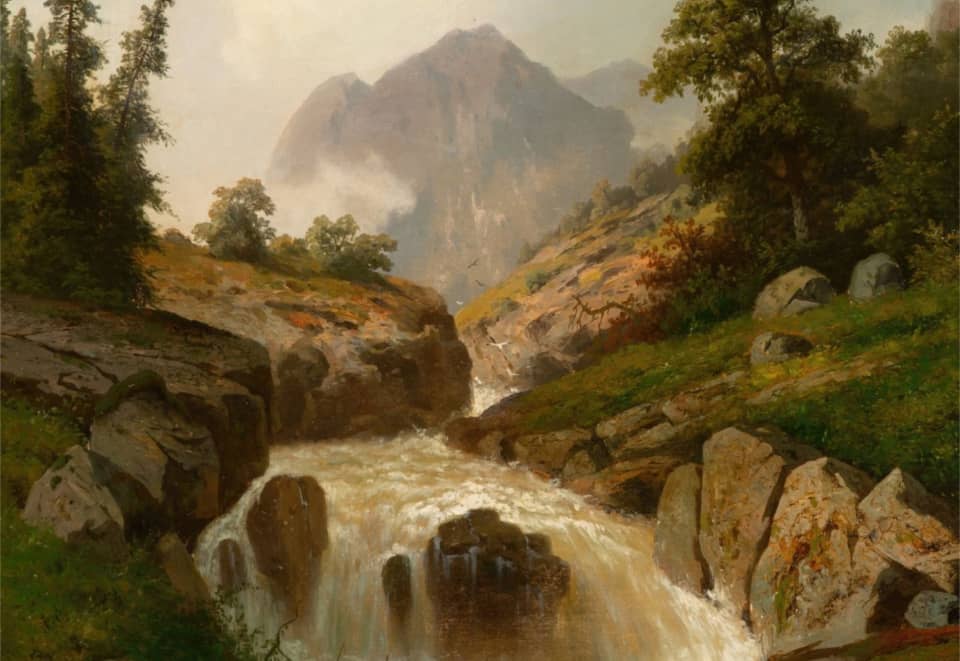
On one hand, you could do a low-stakes travel montage. Have the players contribute to the world around them by asking them to describe things through the eyes of their characters. You could cut out the travel altogether and get to the action by telling them that they have left town and walked for a few hours before finding their destination. Or you could combine the two using something like the Raging River Environment.
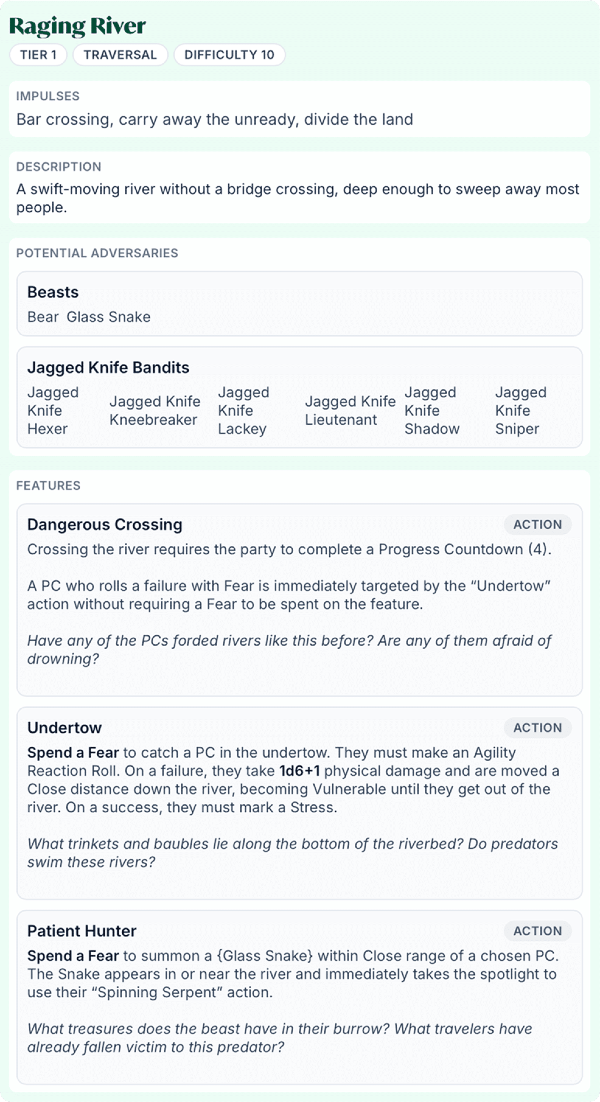
With a 10 Difficulty, success might feel like a foregone conclusion. The duality dice are statistically drawn to the mid-ranges, so a 10 is as trivial a roll as one could (or ever really should) ask for. But there’s plenty that can go wrong here, even before the PCs ever even dip a single toe into the rapidly moving waters of this raging river. There are bandits that frequent this place as evidenced by the potential adversaries list. Ask yourself what that might look like. Perhaps, as the trope might suggest, they asking for “tolls” to secure safe passage across. Maybe a Bear might appear from the underbrush as they approach that the PCs might have to fend off. Its impulses are specifically to create an obstacle to crossing and split the party. The fact that most people know what a river is and how it might be dangerous does most of the work here.
The PCs must cross this river or face consequences. How they do this is through a dynamic countdown called a Progress Countdown. If you haven’t read up on countdowns, you can find them in the CRB on page 162. The Progress Countdown ticks down based on the table on page 163 unless otherwise noted. If the river is larger (or you have more PCs), consider bringing it up to a 6 rather than a 4, so that everyone can contribute.
When starting this or any similar traversal environment, you should have a meta conversation regarding the rules of the skill challenge they are about to embark on. Explain the goal. “You must get across this raging river.” Explain the how. “By describing your actions and then rolling an appropriate trait roll” Then introduce the countdown. “I’m starting a progress countdown represented by this d4. When it ticks down to 0, you’ve successfully crossed the river.”
You see Matt Mercer explain these types of countdowns to the players during Episode 1 of Sallowlands, which I recently deconstructed.
After the challenge has been described and your players know what is expected of them, you go back-and-forth describing the actions and then let the dice tell the story!
If a PC fails with Fear, then you can activate the "Undertow" action without paying its cost! This is where things go badly. The PC takes some damage and is pushed away from the party. I would even say this PC can no longer contribute to the progress countdown and begins to drown (you can find general rules for that on page 168).
Now is a great time to shine the spotlight on another PC and ask them a pointed question, “(drowning PC) just disappeared under the water, is there something you are doing to help?” When they scramble through their inventory and undoubtedly pull out the rope from their pack (I hear it is soft rope, so it must be silk) let them know that any rolls to attempt to save the drowning PC will do a few things.
- It will tick down the drowning PC’s countdown.
- It will not tick down the Progress Countdown because this does not aid them in progressing.
- If they are still in the water, they have disadvantage on this roll due to the situation they are in.
Then they get to decide if getting to the other side is more important than immediately rescuing a party member.
If they do decide to rescue their drowning friend, have them describe how they intend to do so. As for the roll's Difficulty, I would use the Environment’s Difficulty for this (remember, you’re already asking for it to be done at disadvantage). Should this attempt fail, the spotlight turns back to you and now would be a great time to introduce a Patient Hunter to the scene.
This might seem like a lot. There's a combat going and a bunch of different countdowns and the scene is confusing. So instead of describing the Glass Snake as a combatant, I would probably just make the attack roll, deal damage and say that the snake has disappeared back into the water. You could just as easily say it was that swarm of flying razor fish and this small group has passed on upstream, or whatever other damaging complication you might find interesting and fitting for the location.
Traversals are designed to give the GM a way to show progress through a scene or montage without getting bogged down in resource tracking or hex-counting. It is also intended to cause some damage to the PCs (mark a few Armor Slots, or Stress), generate some Hope, and, for you, generate some Fear to use later. Then, once it's over, you cut to the next scene, ready to discover what happens next.
Daggerheart Deconstructed is written by ENNIE Award-winning writer Chris Davidson, author of RightKnight's Guide to Making Custom Adversaries, one of the authors of Incredible Creatures, and Additional Writer for the Daggerheart Core Rule Book.